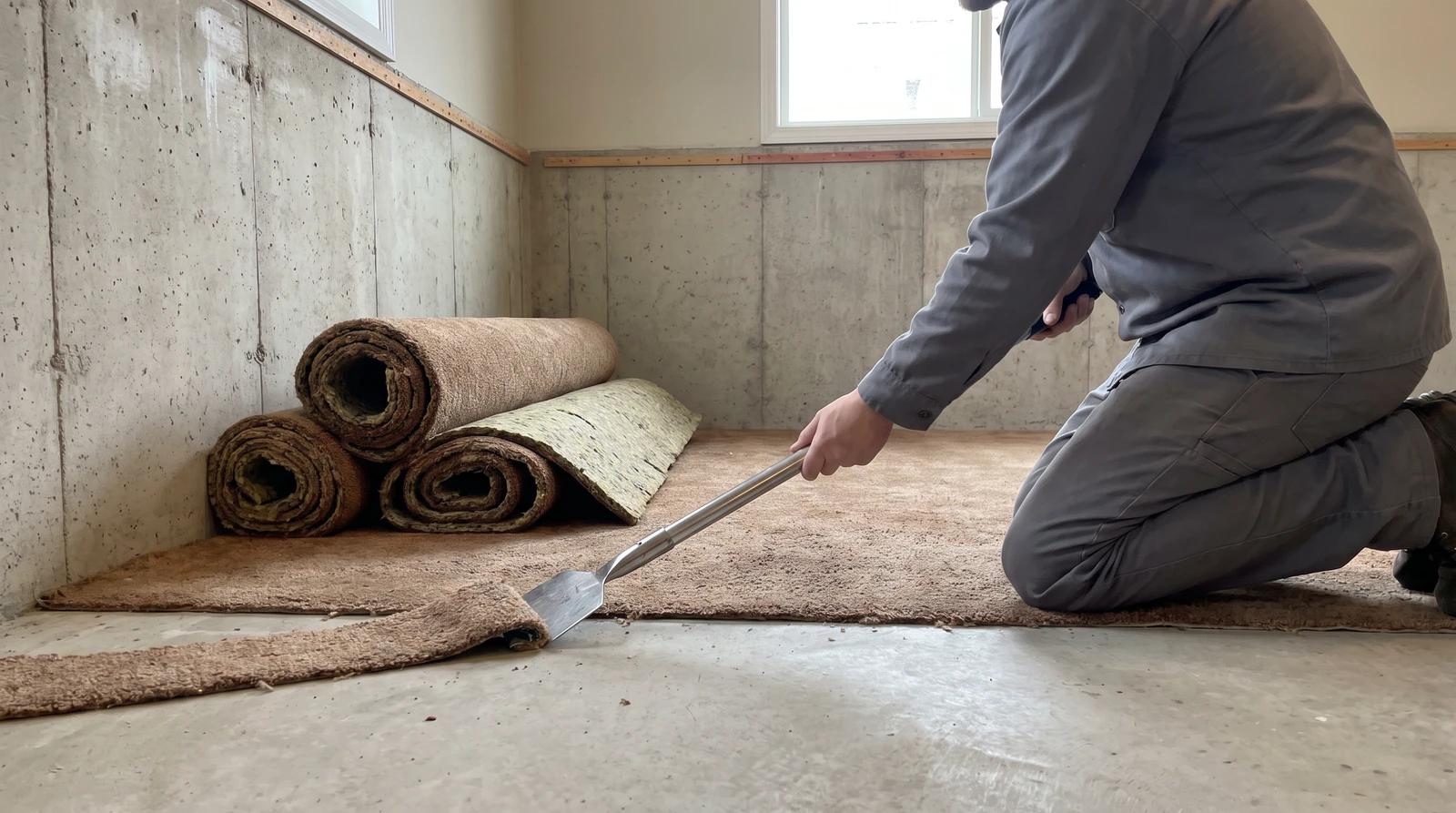
Removing Glue Down Carpet From Concrete Before New Flooring
Removing glue down carpet from concrete is a two-part job: getting the old floor covering up, then getting the glue off the concrete so your new floor has something flat and clean to sit on.
The strips come up with a long-handled scraper and plenty of elbow grease. What's left behind takes more time with the blade, and sometimes a grinder, depending on the floor going in next.
If you're planning carpet removal before new flooring and the old stuff turns out to be stuck down, it's worth knowing what you're in for before you book the installer.
Where glued-down carpet shows up around the Treasure Valley
In most homes, the floor covering is stretched over a cushion and hooked onto tack strip around the edges. Glue-down is the other kind. It's stuck straight to the subfloor, usually concrete, often with nothing in between.
It's common in finished basements, older offices and church fellowship halls. It can turn up downstairs in older houses on the Bench, in older commercial spaces in Garden City, and in ground-floor condos built on concrete.
Outdoor carpet on a porch, patio or garage floor is usually stuck down too.
So how do you tell which one you've got? Pull back a corner inside a closet or at a doorway.
Foam cushion underneath means it's stretched. If the backing is stuck to the floor and comes up with chunks of gray or tan residue, it's glued.
Why removing glue down carpet from concrete takes longer
Stretched carpet comes up fast. You cut it into strips, roll it, pull the pad, and you're mostly onto the tack strip.
Glued carpet fights you the whole way.
It tears instead of peeling, especially once the glue has had decades to cure. You end up slicing narrow strips and prying each one loose with a floor scraper. Some sections let go without much trouble. Others act like they were poured in place.
Trying to rip up a whole room in one sheet only splits the backing. Pull it back slowly, strip by strip.
And getting the flooring up is maybe half the job. The other half is the glue left behind, because the floor has to end up flat and clean enough for whatever's going down next.
That's why we price by the space and the work involved, and why we look at it in person first. Two rooms the same size can be very different jobs depending on how thick it went down and how well it's held. You get a firm price at the estimate, before anything is touched, and it doesn't change when we hit a stubborn patch.
That leftover layer also decides the tooling. Here's how the usual options compare:
| Option | Best for | Trade-off |
|---|---|---|
| Four inch razor scraper or putty knife | Small rooms, thin or soft glue | Slow, and it takes elbow grease |
| Multi-tool fitted with a scraping attachment | Edges, corners, along walls | Covers a small area at a time |
| Grinding machine or concrete polishing equipment with a cup wheel | Whole rooms, thick carpet adhesive, tile or epoxy going down | Dusty, and old black cutback needs testing first |
| Shot blasting | Large commercial floors, old coatings | Specialty equipment |
In most homes, a multi-tool handles the edges and a grinding machine takes the open floor. Shot blasting is mostly for big commercial spaces.
Floors getting new coatings or a polished finish need more than that. That kind of surface preparation opens up the top of the concrete with diamond tooling or concrete polishing equipment.
These jobs fall under our Specialty Carpet Services because the tooling depends on what's stuck underneath, not just the size of the room.
Can you pull glued carpet yourself?
Sometimes, yes. We'd love the job, but a small basement office is doable with a sharp utility knife, a long-handled scraper, something soft to kneel on and some patience.
If you try it, here's the basic order:
- Start pulling carpet at a wall or doorway, where you can get under the edge.
- Score it into narrow strips with the utility knife, then pull it back while you slide the scraper under the backing.
- Knock the high ridges of carpet glue down with a sharp blade on a long handle.
- If you use a remover, test a small spot first and keep the room ventilated.
Quick tip: Swap blades often. A dull blade skates over the residue instead of getting under it.
Where it goes sideways is size. A whole basement in Kuna or a ground-floor office in Nampa turns into a long stretch on your knees.
Then there's the pile. Torn strips with crusty backing don't roll up neatly and often won't fit in your trash cart, so you're looking at a trip out to the Ada County landfill or the Canyon County landfill.
One more honest note. Clean, stretched-in flooring can sometimes get a second life, but the stuck-down kind almost never comes up in reusable shape. We still recycle or donate whatever we can. Less of it qualifies, that's all.
What your new floor needs from the slab
People tend to skip this step. It's usually the one that bites them later.
Luxury vinyl plank and other floating floors want a flat surface. Ridges of old glue can telegraph through thin vinyl or leave planks sitting a little uneven. Vinyl tile flooring material that gets stuck down is even pickier, since every bump shows.
Tile is fussy in a different way. The thinset needs something clean and solid to grab onto, not a skin of old residue. A sound concrete surface, ground clean, gives it that.
Going back down with a new glue-down floor or sheet vinyl? Then the old layer needs to be shaved smooth so the new glue isn't sitting on something weak.
Your installer will have their own standard, so ask them before demo day what condition they want the slab in. Then tell us. We'd much rather prep to their spec once than have them show up, look at the floor and reschedule.
Worth asking: Does your installer want full adhesive removal, or just the ridges knocked flat? Some are fine with a thin, flat film over sound concrete. Others want bare concrete.
Heads up: If your home was built before the 1980s, black "cutback" adhesive under old flooring or tile can contain asbestos. Have a sample tested before anyone sands, grinds or chips at it. It can push the schedule back a little, and the result tells you how that floor needs to be handled.
Carpet removal before new flooring: get the order right
A common mix-up in Eagle and Meridian remodels goes like this. The flooring's ordered, the installer's booked, and nobody has figured out who's tearing out what's there now.
Schedule the tear-out first, ideally with a little cushion before the install. That leaves you some room if the concrete needs extra prep.
It also gives your installer a chance to check the concrete for moisture. Treasure Valley basements can hang onto it after a wet spring or a big snowmelt, and a lot of installers want to test before they lay anything.
If the remodel includes other demolition, like old tile or a wall coming out, plan it for the same window. We do demolition too, so it can all be handled together.
We can sometimes do same-day service. With this kind of job, though, we'd rather give you a realistic day than squeeze you in and rush the prep.
The bottom line
Stuck-down flooring is a slower, messier pull than the stretched kind, and what's left on the concrete matters as much as what comes up. Find out what your installer needs, check for old black cutback, and book the tear-out before the install date.
If you want a firm price on the job in Boise or anywhere else in the Treasure Valley, give us a call at (208) 314-4315. We'll come take a look at the floor, tell you what we see, and you can decide from there. Cash, card and Venmo are all fine.
Frequently asked questions
How do you get glue off a concrete floor?
Knock the thick ridges off the concrete floor first. A floating floor may only need a flat base, while tile and glue-down floors usually need grinding with a diamond cup wheel for full glue removal.
Do citrus removers or acetone work on old adhesive?
Both can soften some carpet glue in a small spot, but they don't remove it on their own and can leave a film. Acetone is also very flammable. Ask your installer first, since solvent residue can keep the new floor from bonding.
What changes the price of a glued-down job?
The cost to remove carpet glue along with the old flooring depends on room size, how well it's held, how clean the concrete needs to be and how much gets hauled away. You get a firm price at the estimate.
Do glued pad, tiles and outdoor carpet come up the same way?
Related reading: How Much Does It Cost to Remove Glued Down Carpet? It Comes Down to the Glue and Carpet Removal Between Tenants in Boise: A Landlord's Prep Guide.
Mostly. A stuck-down pad leaves foam on the floor, and the sun-worn backing on outdoor carpet tends to crumble, so both need more time with the blade. Tiles are often held with a lighter tack and come up easier.
Want us to handle it?
(208) 314-4315More From Our Blog
How to Remove Carpet Gripper From Wood or Concrete Without Gouging It
How to remove carpet gripper from a wood subfloor or concrete slab: where to pry, what to do with leftover nails, and how to bundle old strips safely.
How to Get Rid of Old Carpet: Trash, Recycling or a Removal Crew
How to get rid of old carpet: when your trash bin works, when your installer should haul it, and what a removal crew pulls, hauls, donates or recycles.
How to Remove Glued Carpet and Where All of It Goes Afterward
How to remove glued carpet with the end in mind: cut it, pull it, scrape the glue, then sort what can be donated, recycled or hauled to the landfill.
