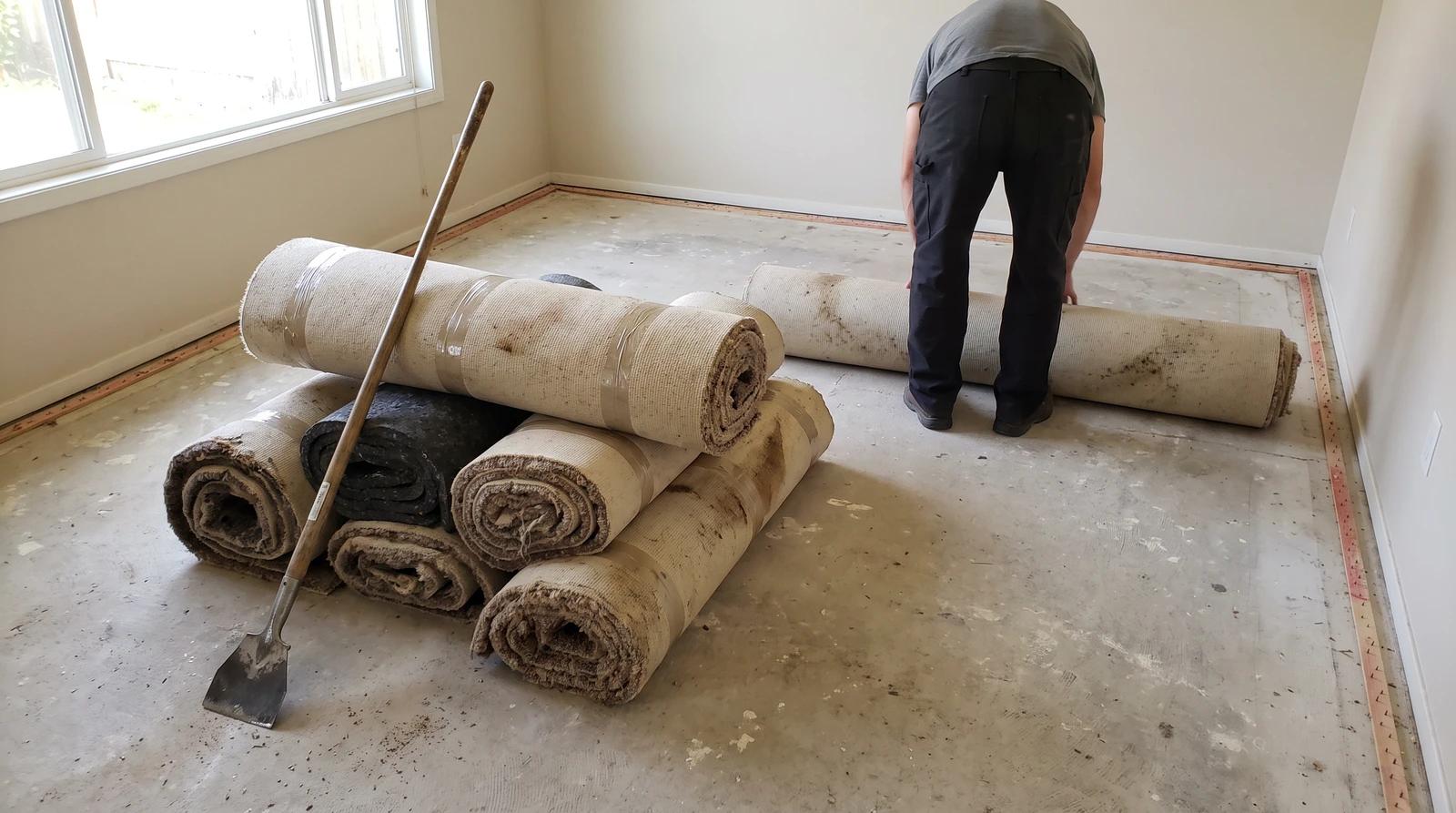
How to Remove Glued Carpet and Where All of It Goes Afterward
How to remove glued carpet comes down to a simple order: cut it into strips, pull each one at a low angle, then scrape what's left until the floor is ready for what goes down next. Then comes the part most people forget: where all of it goes.
It doesn't come up whole. It comes up in pieces, with crumbled foam rubber backing, chunks of pad and dried residue stuck to the back. Some of it can be donated, some recycled, and some can only go to the landfill. Knowing which is which before you start changes how you cut, stack and haul.
You'll find it in basements, offices, rentals and rooms on a slab all over the Treasure Valley.
How to remove glued carpet in pieces you can carry
The most effective way to do it is in strips small enough to control. A torn sheet is heavy and awkward, while narrow rolls stack neatly and carry out one at a time.
Clear the room and check what's underneath
Clearing the room comes first, and it keeps good things out of the landfill.
- Furniture, lamps and decor in good shape are the simplest donations. Moving them out first keeps them free of dust and crumbs.
- Metal transition strips and vent covers you plan to replace can go with scrap metal.
- Baseboards you pry off the wall with a flat bar over a putty knife can go back on later. Mark the back of each one.
Then pull back a corner and look underneath. Tack strip and a loose pad mean it isn't glued, so you can pull it up and roll it whole. A hard, sticky layer or crumbly foam means it's glued and has to come up in strips. Is the floor bare concrete, a wood subfloor or hardwood you want to keep? That tells you which scraper to use and how much water and how strong a product it can take.
Good to know: Carpet tiles are the glued-down product most likely to come up reusable. Many sit on a tacky release adhesive, so they lift by hand once a plastic scraper gets under an edge. Stacked flat and kept dry, they have a real shot at a second home.
Cut it into strips
Use a sharp utility knife and keep spare blades handy, because the backing dulls them fast. Cut the room into strips a few hand-widths wide, running the long way, and finish cutting before you start pulling. Keep the pressure light so the blade only goes through the backing. On hardwood, go lighter still, since a deep knife line can show up again after a refinish.
Pull low and slow
Work from the far side of the room back toward the door. Fold the end of a strip back over itself and keep your pull close to the floor. If you pull it up straight, the fibers tear off and the backing stays stuck, which means more scraping later.
When a strip stalls, don't yank it. The easier way is to slide a scraper under the stuck spot and push while keeping light tension on the strip.
Roll it face-in and tie it
Roll each strip face-in so the crumbs stay inside, then tape or tie it shut. That keeps the mess off your clothes and the door frames on the way out.
Quick tip: Keep tack strip, staples, nails and metal trim in their own pile. Tack strip is full of sharp points, so bundle it and wrap the ends before it goes in a bag.
Then scrape what's left
How bare should the floor be? Getting this right depends on what goes down next. A floating floor or new pad can often sit over a thin, flat layer of residue, while tile usually needs it gone. Check the new floor's install instructions so you don't scrape more than you need to.
On a concrete slab: hot water and a long scraper
On a slab, the most effective tool for what's left is a long-handle floor scraper. Old foam rubber backing tends to crumble instead of peeling, so the easier way through it is a hot water dwell + scrape. Wet a small section, let it sit until the backing softens, then push the scraper through it at a shallow angle. Wipe up the slurry with a cloth or a wet vac before it dries.
Work in small sections, since summer heat evaporates the water fast and a cold basement in winter keeps the glue stiff.
On wood: go slow with a plastic scraper
Go gently here. Start with a plastic putty knife, use a damp rag instead of soaking the floor, and towel each patch off right away. A heat gun on low can soften old residue with no water at all. If you're refinishing anyway, you don't have to get every speck. Just get the lumps and gummy spots that would clog a sander.
For patches that stay behind, a mastic remover made for flooring softens what's left so it scrapes off instead of chipping. Read the label, open the windows and test a small spot first. Then wipe the floor so leftover film doesn't keep the new floor from bonding.
Heads up: Black, tar-like adhesive in an older building may be cutback mastic, which can contain asbestos. Have a sample tested before you scrape hard, sand or grind it. A positive result also changes how the waste is handled.
Where does all of it go afterward?
Here's the honest part: the carpet itself is the hardest thing to give a second life.
Donation
Most donations come from what left the room first, like furniture, rugs, decor and stacks of clean tiles. Cut strips of sheet carpet rarely qualify, so call ahead and ask what a donation center takes.
Recycling
A separate pad that came up in decent pieces has better odds than foam bonded to the back. Metal is the easy part, since tack strip and trim can go with scrap metal. Recyclers change what they accept, so check their current rules before you haul.
The landfill
In Ada County, the rest goes to the Ada County landfill, and Canyon County has its own site for Nampa, Caldwell and the west side of the valley. Check current hours and fees first, and cover your load. Your regular curbside trash usually won't take a whole room of it.
How much does glued carpet removal cost?
Cost and time come down to a handful of things:
- The size of the space, and whether it's one room or a whole floor.
- How it's stuck down. Tiles come up faster than sheet carpet, and a glued pad under a glued top layer is two jobs.
- What's underneath. Some floors can take a heavier scraper and more water, while hardwood needs a slower hand.
- How bare the floor needs to be for the next flooring.
- Stairs and access, like upstairs rooms and tight basement stairs.
- How much there is to haul, and how much of it can be donated or recycled.
Plenty of people do this themselves just fine. If you'd rather hand it off, glued-down floors are part of what we do. Boise Carpet Removal is a locally owned, family-run crew that pulls up carpet and flooring across the Treasure Valley, from Boise and Meridian to Nampa and Caldwell.
Pricing is based on the space and the work involved. At a free on-site estimate, we look at everything in that list and give you a firm price before anything is touched, with no hidden fees. Much of what we haul is donated or recycled.
Frequently asked questions
Is carpet normally glued down?
Not usually in houses. Most of it in homes is stretched over tack strip and a loose pad, while the glued kind shows up more in basements, offices and rentals.
Can you leave old adhesive on the floor?
Sometimes. Flat, well-stuck residue can stay under a floating floor or a new pad, but ridges, lumps and anything going under tile should come off.
Will a mastic remover work on old adhesive?
Usually. One made for flooring softens the old layer so it scrapes off, though thick layers take longer and you'll still need to wipe up the film.
Do you need a permit to pull up flooring in Idaho?
The Specialty Carpet Services page covers what the service includes and how the estimate works.
Related reading: How Much Does It Cost to Remove Glued Down Carpet? It Comes Down to the Glue and Carpet Removal Between Tenants in Boise: A Landlord's Prep Guide.
Pulling up carpet usually doesn't need one. If the project grows into demolition, check with your city or county building department first.
Want us to handle it?
(208) 314-4315More From Our Blog
How to Remove Carpet Gripper From Wood or Concrete Without Gouging It
How to remove carpet gripper from a wood subfloor or concrete slab: where to pry, what to do with leftover nails, and how to bundle old strips safely.
How to Get Rid of Old Carpet: Trash, Recycling or a Removal Crew
How to get rid of old carpet: when your trash bin works, when your installer should haul it, and what a removal crew pulls, hauls, donates or recycles.
Commercial Carpet Removal Machine: What It Does and What It Leaves Behind
A commercial carpet removal machine strips glued carpet off the slab. Here's the hand work, glue cleanup and hauling the machine leaves behind for you.
