How to Remove Carpet Gripper From Wood or Concrete Without Gouging It
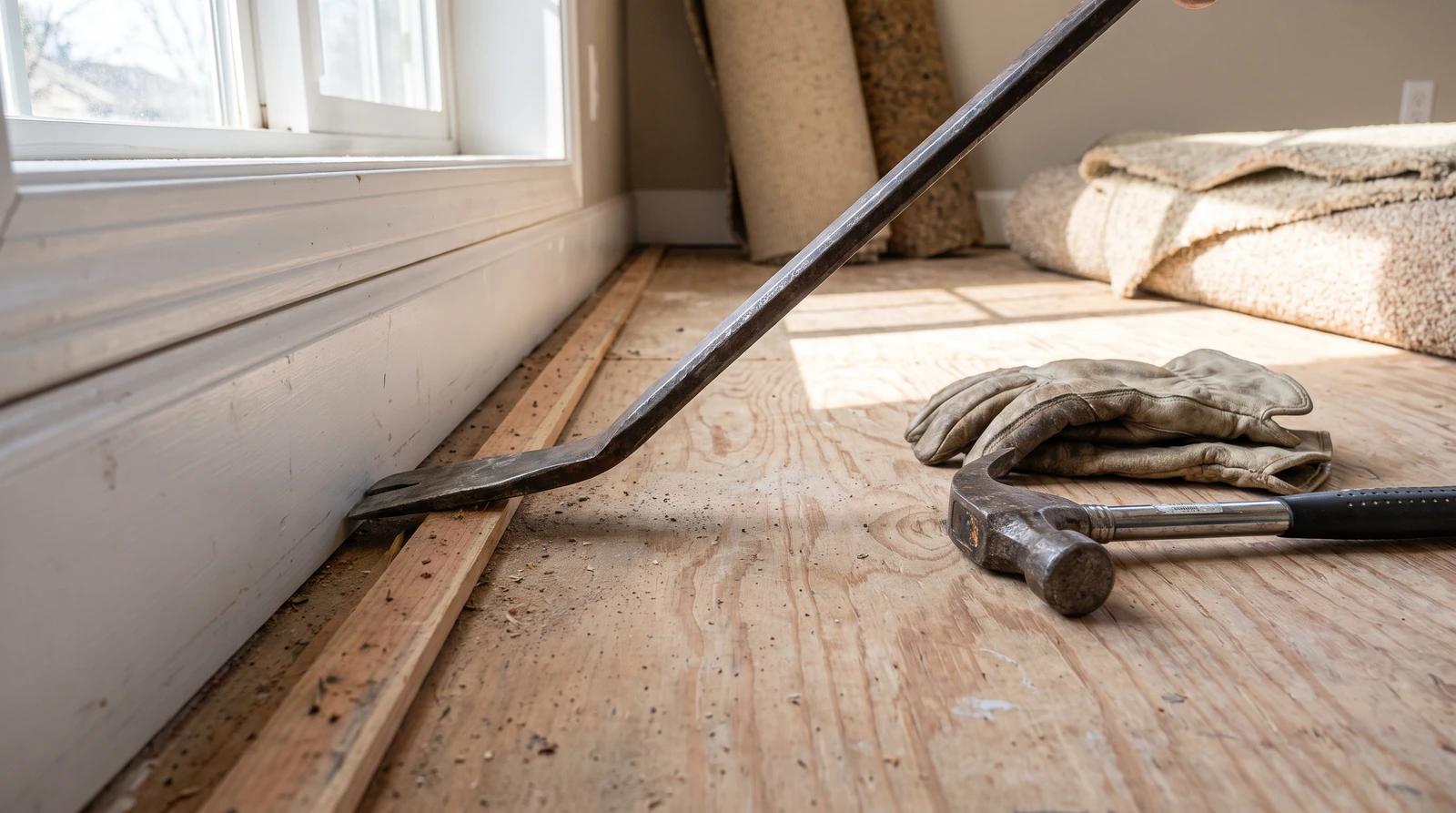
How to remove carpet gripper without damaging the floor comes down to one habit: slide a flat pry bar under the wood right next to each fastener and lift a little at a time. That way the subfloor or slab underneath comes through without gouges or chipped edges. Prying in the middle of a run is what splits the wood and digs into the floor.
Pulling it is a normal part of most tear-outs, so this guide keeps going after it's off: the leftover fasteners, the broken bits, and where the old pieces should go.
What's the easiest way to pull up tack strips?
The easiest way to pull tack strips is a flat bar and a hammer, worked from a corner, one nail at a time. On most wooden floors, those two tools are all you need.
Tack strip and gripper strip are two names for the same thing. It's a thin piece of wood with angled tacks that hook the edges of the old covering and hold them tight around the room.
Here's what matters. The fasteners hold it down, not the wood. The best way to protect the floor is to lift right at each one and let the rest follow. Lift between them and the wood snaps while they stay put.
Good to know: This part comes up last. Cut the old covering into rows with a utility knife, roll it out, then pull the pad and its staples so you can see every fastener. If the pad is stuck to a pet stain, cut around that spot so the rest rolls out in one piece.
How to remove carpet gripper from wood and concrete floors
The method depends on what it's fastened to. Wood subfloors, slabs with masonry fasteners and glued-down runs each need a slightly different touch. Wear heavy gloves and safety glasses, because the tacks are sharp and the wood can snap when it lets go.
1. Start at the end of a run, not the middle
Start at each corner, or where two runs meet. The end is the one spot where the bar slides under without forcing it.
Pick a middle spot and you're jamming the bar between two fasteners that are both holding tight. That's where gouges happen, even when the middle looks loose. Once the first fastener lets go, grab the free end with a gloved hand and keep light upward pressure as you go.
2. Wood subfloor: lift at every nail so the wood doesn't split
On plywood or OSB, set the bar right next to a fastener, tap it under with a claw hammer, and lift a little. Move to the next one and do the same. Then go back and lift the first one higher. Once the first few let go, a small crowbar lifts the rest easily.
That slow walk down the run keeps the pressure on the fastener instead of the soft subfloor. Keep the flat part of the bar against the floor and rock it gently. Rock hard in one spot and you'll leave a dent you can feel under thin vinyl plank or hardwood. If either one is going down next, rest the bar on a thin scrap of wood as a pad.
Wood near a slider door, a water heater or a pet's favorite corner can go soft. Rotten strips crumble, so pull them off in chunks, then deal with the fasteners separately.
3. Concrete: masonry fasteners vs. glue
On a slab, the strip is held by short masonry fasteners, by glue, or both. Look at the top. Visible heads mean it's fastened, though there may be glue under it too.
For the nailed ones, use the same bar-at-each-fastener method, just gentler. Concrete doesn't dent. It chips, and a chipped edge along the wall can show under a thin new floor. Those fasteners are hardened steel that tends to snap if you lever it sideways, so pry them straight up.
Glued runs are where most people get stuck. Tap the bar along the glue line a few inches at a time. If a section won't budge, drive a screw partway into the wood, hook a claw hammer under the head and pull straight up. On a long run, add a screw every so often and repeat. An oscillating tool with a scraper blade can also cut through the glue.
Heads up: Black, tar-like adhesive on an older slab can contain asbestos. If that's what you find, get it tested before you scrape, sand or grind.
4. Pulling what stays behind
Some fasteners stay in the floor when the wood lifts, and some pieces break and leave stubs. Pulling both is the part people skip, and the part you'll feel later under the new floor.
- Leftovers sticking up from wood: use pliers, or end nippers rolled against the floor.
- Broken stubs: tap a flathead screwdriver under them, pry them up, then grab one end and pull it free.
- Snapped masonry fasteners: knock down anything sharp that sticks up, or snip it with side cutters if there's enough to grab.
- Loose tacks: sweep twice. They hide in the dust along the wall.
Then vacuum the edges and check each corner. A pet stain along the wall shows up now, so seal it before anything new covers it.
What tools does the job take?
A flat bar and a hammer handle most rooms. Everything else makes the work faster or cleaner.
- Flat bar or small crowbar: prying at each fastener
- Hammer: tapping the bar under, and pulling screws on glued runs
- Flathead screwdriver: tight spots and broken stubs
- Pliers, end nippers or side cutters: whatever's left in the floor
- Utility knife or hook knife: cutting out the old covering and pad first
- Oscillating tool: often the easiest fix for strips glued to concrete
- Heavy gloves and safety glasses: the whole job
A staircase takes more patience. There's often a tacked piece at the back of each tread plus a lot of staples. Use a smaller bar and the same method, and go slow near the nosing so you don't chew up the edge. Pull the staples with pliers as you go, so you're not kneeling on them later.
Where do the old pieces go once they're up?
The old wood is full of nails, so it can't go out with rolls that are being donated or recycled. Give it its own pile from the first piece.
Bundling is an easy way to keep anyone from getting hurt handling it:
- Stack the pieces with the tacks facing in toward each other.
- Tape the bundle tight at both ends.
- Wrap it in cardboard or a scrap of old pad.
Loose pieces in a trash bag poke right through. Curbside pickup can have rules about construction debris, so check with your hauler. Otherwise it's a dump run to the Ada County landfill, or Canyon County's if you're in Nampa or Caldwell.
On a full tear-out, pulling, bundling and hauling the old wood is part of the job, and keeping it in its own pile keeps the rest of the haul clean. Staircases and glued-down jobs usually take the most time.
Worth asking: If you're hiring out the tear-out, ask whether the edge pieces and staples come up too. It's easy to assume, and annoying to find a ring of tacks around the room after the crew leaves.
Frequently asked questions
Do you have to pull it up before new floors go in?
Yes, if you're putting down tile, vinyl or wood next. Hard floors need a flat, bare edge. If you're going back to wall-to-wall and the old pieces are solid, your installer may keep them.
Do installers reuse what's already there?
Often, yes. Installers tend to leave sound runs in place and replace only broken, rotten or loose sections. Ask before you pull anything, since keeping good ones can save a step.
What moves the cost of a tear-out?
It depends on the square footage, the number of rooms and staircases, whether it's glued down, and how much there is to haul. An on-site estimate is the way to get a firm price before any work starts.
What will dissolve the glue?
Citrus-based or soy-based adhesive solvents can soften many of these glues so they scrape up, and warm water loosens some water-based ones. Test a small spot first and give it time to soak in. If softened glue still won't scrape, try an oscillating tool with a scraper blade.
The short version
Start at the ends, lift at each fastener, pull leftover nails with end nippers and bundle the pieces points-in. That's the easy way to get the old wood up without hurting what's underneath.
The Specialty Carpet Services page covers what the service includes and how the estimate works.
Related reading: How to Remove Glued Carpet and Where All of It Goes Afterward and How Much Does It Cost to Remove Glued Down Carpet? It Comes Down to the Glue.
If you'd rather hand it off, Boise Carpet Removal handles the whole tear-out and haul-away across Boise, Meridian, Eagle, Nampa, Caldwell and the rest of the Treasure Valley. Call (208) 314-4315 for a free on-site estimate and a firm price before anything's touched. No hidden fees, and we take cash, card and Venmo.
Want us to handle it?
(208) 314-4315More From Our Blog
How to Get Rid of Old Carpet: Trash, Recycling or a Removal Crew
How to get rid of old carpet: when your trash bin works, when your installer should haul it, and what a removal crew pulls, hauls, donates or recycles.
How to Remove Glued Carpet and Where All of It Goes Afterward
How to remove glued carpet with the end in mind: cut it, pull it, scrape the glue, then sort what can be donated, recycled or hauled to the landfill.
Commercial Carpet Removal Machine: What It Does and What It Leaves Behind
A commercial carpet removal machine strips glued carpet off the slab. Here's the hand work, glue cleanup and hauling the machine leaves behind for you.
