How Much Does It Cost to Remove Glued Down Carpet? It Comes Down to the Glue
The answer to how much does it cost to remove glued down carpet comes down mostly to the glue: how hard it's holding, what it's stuck to, and how clean the floor has to be for whatever goes down next. Pulling the carpet up is the quick part. Scraping the leftover glue and pad off is where the time goes, and time is what you're paying for.
How much does it cost to remove glued down carpet?
The price to remove glued down carpet comes down to how much scraping the job needs, more than how big the room is.
Most pages you'll find quote an average price per square foot. That's a fair starting point, but it mostly describes loose carpet on tack strips, not carpet that's been stuck to a slab for years.
That's why carpet removal costs are hard to judge over the phone. The same square foot can peel up easily in one house and need slow scraping in the next.
How well the glue is holding (fresh, brittle or half-failed)
Newer glue grabs hard. It fights you on the way up and leaves a thick, tacky layer behind.
Old glue that's gone brittle is a different job. The carpet may pop loose easily, but what's left can be hard as a shell and chips off in flakes instead of peeling.
Half-failed glue is the mixed bag. Some spots lift with almost no effort and others hold like they went down last week.
The padding matters too. Some carpet has its own padding attached to the back, while other jobs have a separate layer stuck down underneath, so there are two layers to pull and scrape.
What it's glued to: a concrete slab or a wood subfloor
Concrete can take a beating. A stiff scraper can work hard on a slab without hurting it, so the question is just how stubborn the glue is.
A wood subfloor needs a lighter hand. Plywood and OSB can gouge or splinter if you scrape too aggressively.
Any damage has to be patched before the new flooring goes in, so carpet adhesive on wood comes off slowly and carefully.
Heads up: Some older homes have dark, almost black glue under the carpet. Certain old glues contained asbestos, so have it tested before anyone scrapes or grinds it. If it comes back positive, that's a job for a licensed abatement company, not a removal crew.
How clean the floor has to be for the new flooring
What goes down next decides how much adhesive removal the job really needs.
A floating floor can usually go over a little leftover residue as long as the surface is flat. Glue-down vinyl, glue-down wood and tile want it much cleaner. Flat enough and clean enough to bond to are very different amounts of labor.
Worth asking: Before you book removal, ask your flooring installer exactly what they need the surface to look like. Get it in plain words, like "thin, smooth residue is fine" or "down to bare concrete," so it gets scraped right the first time.
On a remodel project, flooring removal and the new install are sometimes quoted by different people. Make sure one of them owns the scraping.
Room size, furniture, stairs and access
Square footage still matters. More sq ft means more cutting, more pulling and more to scrape. But the layout can matter just as much.
That's why carpet removal on a big open slab can work out cheaper per square foot than a small space full of closets, corners and stairs.
Things that add labor:
- Furniture that has to be moved out first
- Stairs, which are slow, careful hand work
- Closets, hallways and tight corners
- Basements with a narrow stairway up and out
Clearing the room before the crew shows up is an easy way to keep labor costs down. If you've got stairs or other awkward spots, mention them when you ask for a quote.
Hauling and disposal of carpet, pad and scraped adhesive
Pulled-up carpet is heavy and messy. The rolls, the loose backing and the scraped glue all have to go somewhere.
If there are tack strips around the edges, they get pulled and hauled too, since their nails can catch on new flooring.
Carpet disposal is part of the removal cost. Doing it yourself means loading, tarping and driving it to the Ada County landfill or the Canyon County landfill.
What is the easiest way to remove glued-down carpet?
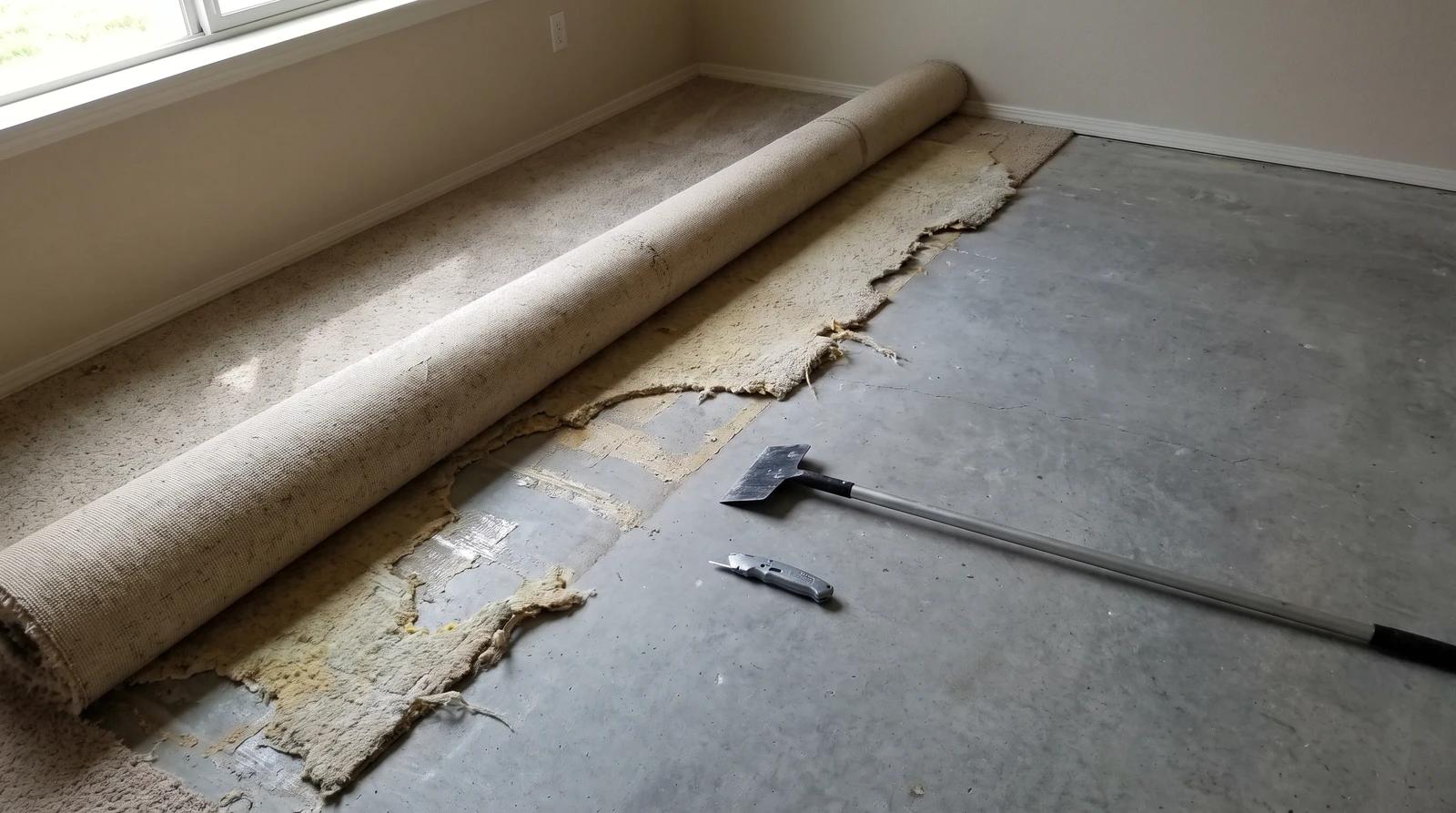
The easiest way to remove glued-down carpet is to cut it into narrow strips, peel each one back low and slow, then scrape what's left. Trying to roll up a whole room at once is how chunks tear off and stay stuck.
Cut the carpet into narrow strips
Use a sharp utility knife and plenty of spare blades. Cut them narrow enough to pull by hand. The more stubborn the glue, the narrower they should be.
On wood, cut lightly so you don't score the boards underneath.
Pull each strip back at a low angle
Start at one end, grab the carpet and pull it back over itself, staying low. A low angle peels the carpet off the glue instead of tearing the backing apart.
Good to know: Glue softens a bit when it's warm and gets more brittle when it's cold. The same carpet can pull differently in July than in a cold basement in January.
Scrape the leftover pad and adhesive off the floor
Once the carpet is up, you'll find patches of pad, backing fibers and glue left behind. A long-handled floor scraper does most of this work. Keep the blade sharp and work in overlapping passes.
How far you go depends on what's going down next.
Is it cheaper to remove carpet yourself?
Removing carpet yourself is cheaper in cash, but not always once you count the time, the tools and the disposal. With carpet that's stuck down hard, that gap closes fast.
A DIY carpet removal job means buying or renting a scraper, blades, knee pads and gloves, then spending a long time on your knees. You still need a way to haul heavy, dirty rolls to the landfill.
Scrape too little and your installer may send you back to do more before they'll start. Scrape too hard on wood and you may be paying for repairs.
Removal professionals bring the scrapers and haul it all off. Some crews quote labor only and leave the haul-away to you, so check what's included before you compare.
If it's one small room and you've got a free weekend, doing it yourself can make sense. For a whole house, stairs or a slab that has to be truly clean, get a price first.
What to do with the floor after removing carpet?
What you do with the floor after removing carpet depends on what's going on top of it. Each kind of flooring needs a different level of subfloor preparation.
Floating floors and vinyl plank
Floating floors, including most click-together vinyl plank and laminate, don't bond to what's underneath. They need a flat, dry surface, and a thin layer of old residue is often fine. Glue ridges and lumps still have to come off, because they'll show through or make the planks flex.
Glue-down flooring and tile
Glue-down vinyl, glue-down wood and tile need the most prep. Old glue can keep new glue or mortar from bonding, so the surface usually needs to be scraped close to bare.
Leaving or sealing bare concrete
Some people pull the carpet, see the slab and decide to keep it. It has to be scraped very clean first, since stain and sealer won't hide old glue. If anything was nailed down around the edges, expect some patching.
Questions people ask about glued down carpet removal
Is it hard to remove carpet yourself?
Loose carpet isn't too hard for most people to pull up. Stuck-down carpet is a lot harder, because the scraping is slow, physical work and the haul-away is heavy. DIY works best in a small space where the glue lets go easily.
What is the most effective tool for removing old carpets?
A sharp utility knife for cutting and a long-handled floor scraper for the glue do most of the work. On big slabs, a powered scraper speeds things up a lot.
Is it healthier to not have carpet?
Hard floors are easier to keep clear of dust, pet hair and spills, which some people with allergies prefer. Old carpet can hold years of dust and allergens down in the backing, even with regular vacuuming. Well-kept carpet can be fine too, so it mostly comes down to what you want to maintain.
Do carpet fitters charge to remove old carpet?
Many carpet fitters and flooring contractors can charge separately for removal and disposal, while some include it. When you ask how much does it cost to add removal, check whether the quote is labor only or covers tearing out, scraping and hauling the old carpet.
Getting a firm price on glued carpet removal
If this is one step in a bigger project, tell us what goes down next so the scraping matches it.
Boise Carpet Removal gives free on-site estimates with a firm price before anything is touched, covering cutting, pulling, scraping to the level your new floor needs, hauling, and donating or recycling what we can. No hidden fees.
The Specialty Carpet Services page covers what the service includes and how the estimate works.
Related reading: Carpet Removal Between Tenants in Boise: A Landlord's Prep Guide and Mobile Home Carpet Removal in Boise Before New Flooring.
We work across Boise, Meridian, Eagle, Nampa, Caldwell and the rest of the Treasure Valley. Call (208) 314-4315 when you're ready.
Want us to handle it?
(208) 314-4315More From Our Blog
How to Remove Carpet Gripper From Wood or Concrete Without Gouging It
How to remove carpet gripper from a wood subfloor or concrete slab: where to pry, what to do with leftover nails, and how to bundle old strips safely.
How to Get Rid of Old Carpet: Trash, Recycling or a Removal Crew
How to get rid of old carpet: when your trash bin works, when your installer should haul it, and what a removal crew pulls, hauls, donates or recycles.
How to Remove Glued Carpet and Where All of It Goes Afterward
How to remove glued carpet with the end in mind: cut it, pull it, scrape the glue, then sort what can be donated, recycled or hauled to the landfill.
