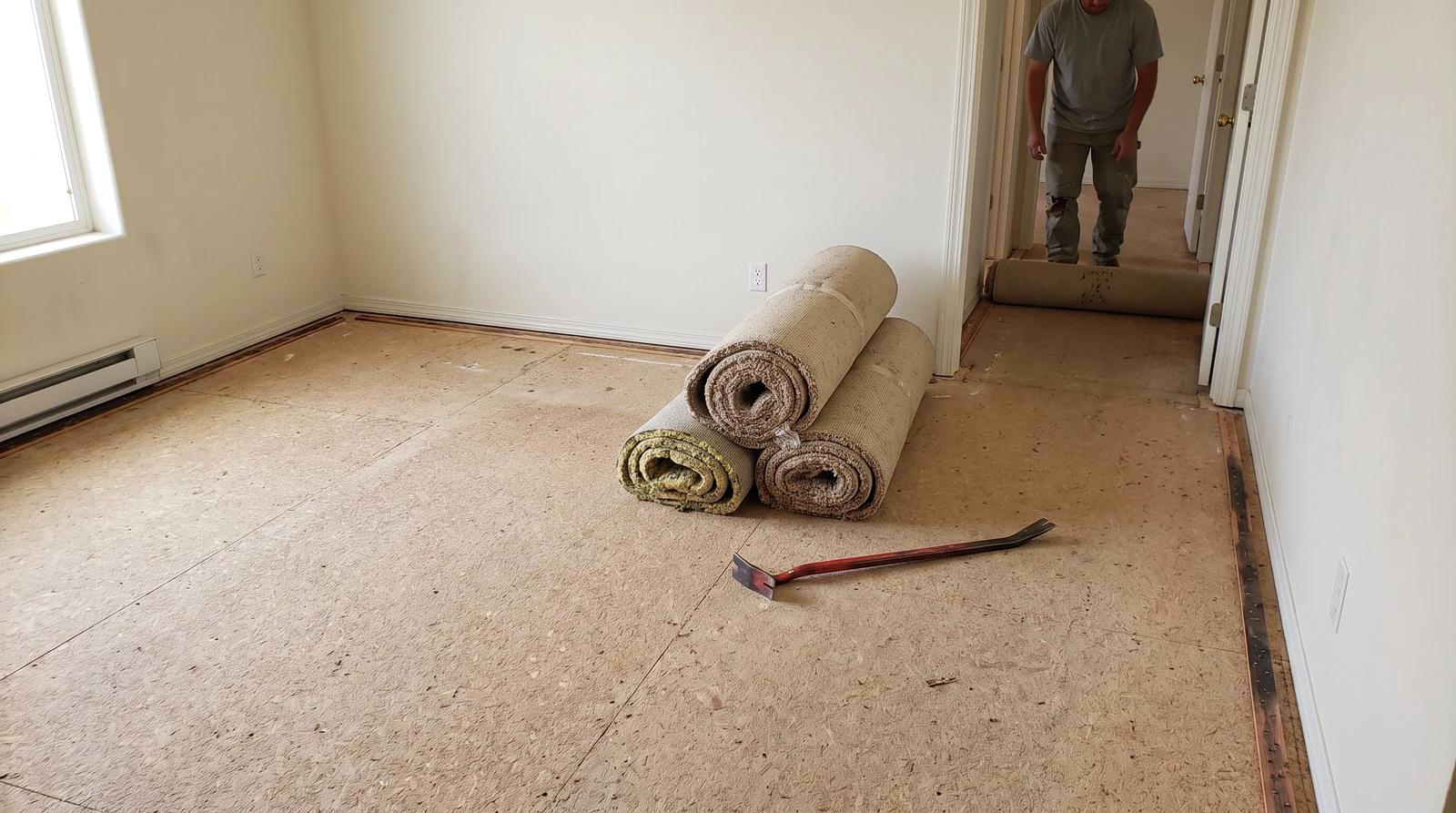
Removing Carpet in Mobile Home Floors Before New Flooring
Removing carpet in mobile home floors comes down to protecting what's underneath it. Many manufactured homes sit on a particleboard subfloor that doesn't like water or prying, the old covering can run under interior walls, and every fastener has to come out before anything new goes down. Go slow at the edges, check for soft spots, and test any old sheet goods or tile before you scrape them.
That's why tear-out in a manufactured home works a little differently. Pulling it isn't harder, but what's underneath changes how careful you need to be.
What's under the old flooring in a manufactured home?
Pull up the covering in a site-built house in the North End or on the Bench and you'll usually find plywood, OSB or sometimes old hardwood. Manufactured homes, especially older ones, often have particleboard or a similar pressed-wood subfloor instead.
Why does that matter? Particleboard handles foot traffic fine, but not water or prying.
If it's ever gotten wet from a leaky water heater, a dishwasher line or a bathroom with years of splashing behind it, it can swell, go soft and crumble at the edges. You often can't tell until everything's up.
The other surprise is how it went in. In a lot of manufactured homes, the original carpet was laid at the factory before some interior walls were set. So it can run under the walls instead of stopping at a tack strip along the baseboard.
It's a lot like an RV, where the covering often goes in before the cabinets. You can't just roll that up. It gets cut cleanly along the wall line, and the piece trapped underneath stays where it is.
Removing carpet in mobile home floors without wrecking the subfloor
The goal is a bare, clean subfloor that's ready for whatever goes down next. Here's the order that works for most homes:
- Empty the space. Move the furniture out and take doors off their hinges if they'd get in the way. You can start anywhere, but an empty space is the easiest place to see how everything was put in.
- Cut it into strips. A utility knife or a sturdy box cutter does the job. Narrow rolls are a lot easier to get through the tight hallways and doors these homes tend to have.
- Pull the pad. It's usually stapled, sometimes glued in spots. That part goes quick.
- Get the staples out. Factories often fasten both layers straight to the subfloor, so expect plenty of them. They're the slow part, and every one needs to come out or get driven flush before anything new goes down.
- Work the tack strip loose. Where there is any, it's nailed into that same subfloor. Pry it too hard and a chunk of particleboard comes up with it, so work it a few inches at a time.
Quick tip: Change blades often. The backing dulls an edge fast, and over a whole home you'll go through countless blades. A dull blade is how people slip and gouge the particleboard.
Pulling all those fasteners is tedious, but it's not difficult. Kneepads, a flat pry bar and a pair of pliers handle most of it. Going slow here is what keeps one project from turning into two.
Don't forget the outside. Plenty of people pull the old outdoor carpet off the landing or the front steps at the same time. It holds water against the wood, so look closely at the boards once it's off.
Heads up: If you find sheet vinyl or old tile underneath in an older home, don't scrape or sand it until it's been tested. Some of those older materials and adhesives contain asbestos, and it's disturbing them that causes the problem. Sending a sample to a testing lab is a small step, and it gives you the information you need before anyone starts scraping.
Can you redo floors in a mobile home?
Yes. Putting down new plank or tile in a mobile home can completely change how the space feels. The catch is that the subfloor has to be sound first.
Once the old layers are up, walk the whole thing. Slowly. Pay extra attention near the bathroom, the kitchen sink, the water heater closet and any exterior door.
A spongy feel, a raised edge or a dark stain usually means water got in at some point. That section needs to be cut out and replaced before anything goes over it. Any space with a water line deserves a second walk-through.
Luxury vinyl plank, laminate and tile all want a flat, solid surface, and none of them will hide a soft subfloor for long. Swap a worn living area for new plank and the whole space feels bigger and cleaner. A solid base underneath keeps it that way.
Once everything's up, we'll tell you straight what we see. Subfloor repair is a separate job, though, so line it up before your installer shows up.
Can I remove carpet by myself?
Yes. You can do it yourself with a free weekend, good gloves, a sharp utility knife, plenty of spare blades and a plan for disposal. If you've ever stripped out an RV, you already know the feel of it: it's not difficult, just tedious work on your knees.
Where it gets tricky is the subfloor. Rushing the tack strip, gouging particleboard or missing a soft spot can turn a simple weekend project into a bigger one. Problems often show up only after everything's pulled, so leave some slack in your plan.
If your home sits in a park, whether that's in Garden City, Nampa, Caldwell or out toward Kuna and Star, read the community rules before you schedule anything. Some parks limit work hours, where a trailer or dumpster can sit and how long debris can stay outside.
Access matters too. Steps, narrow entries and tight turns all change how the work goes. If you're also clearing the landing, make sure the steps are solid before anyone carries heavy rolls over them.
Tear-out debris adds up fast. Count the whole home plus the pad, and a modest single-wide makes a bigger pile than most people picture. You can haul it yourself to the Ada County landfill or the Canyon County landfill. Check current hours and fees first, and know that wet rolls are a lot heavier than dry ones.
| Option | Makes sense when | Keep in mind |
|---|---|---|
| Do it yourself | You have time, a way to haul debris and no old sheet goods or tile to test | Fasteners and tack strip take the longest |
| Hire a tear-out crew | You'd rather keep your weekend, or the pile is too big for your vehicle | Ask what's included: pad, fasteners, tack strip and haul-away |
| Ask your flooring installer | Their crew already handles tear-out | Some charge for tear-out separately, so ask up front |
When we haul it, we look for anything that can be recycled or donated before the rest goes to the landfill. Clean, newer pad and remnants sometimes get a second life. Old, stained rolls usually don't.
Whoever does the work, the advice is the same: go slow around the edges, test anything old before you scrape it, and walk the bare subfloor before anything new goes down.
Manufactured home tear-outs are part of what we do. If you'd rather keep your weekend, Boise Carpet Removal handles them across Boise, Meridian, Nampa and the rest of the Treasure Valley. We'll look at the space and give you a firm price before anything's touched. Give us a call at (208) 314-4315 when you're ready.
Frequently asked questions
Is it unhealthy to leave old flooring down?
Old carpet and pad can hold years of dust, dander and spills that regular cleaning doesn't fully reach. If it smells musty or has ever been wet, pull it. Getting it out can completely change how the place smells, and trapped moisture hurts the subfloor too.
What makes tear-out cost more or less?
It depends on how big the home is, whether the pad is glued or stapled, how many fasteners and how much tack strip are left, how easy the home is to get in and out of, and how much there is to haul. Ask whether haul-away is included, and get a firm quote after someone sees the space.
Can you steam clean instead of tearing it out?
Steam cleaning can freshen fibers that are still in decent shape, but ask the cleaner for a light-water method, since particleboard doesn't like getting wet. If the pad is soaked or the subfloor feels soft, cleaning won't fix that.
Should the pad come out too?
The Specialty Carpet Services page covers what the service includes and how the estimate works.
Related reading: How Much Does It Cost to Remove Glued Down Carpet? It Comes Down to the Glue and Carpet Removal Between Tenants in Boise: A Landlord's Prep Guide.
Yes. Whatever goes down next needs a bare, flat subfloor, so the pad, every staple and any tack strip all come out first.
Want us to handle it?
(208) 314-4315More From Our Blog
How to Remove Carpet Gripper From Wood or Concrete Without Gouging It
How to remove carpet gripper from a wood subfloor or concrete slab: where to pry, what to do with leftover nails, and how to bundle old strips safely.
How to Get Rid of Old Carpet: Trash, Recycling or a Removal Crew
How to get rid of old carpet: when your trash bin works, when your installer should haul it, and what a removal crew pulls, hauls, donates or recycles.
How to Remove Glued Carpet and Where All of It Goes Afterward
How to remove glued carpet with the end in mind: cut it, pull it, scrape the glue, then sort what can be donated, recycled or hauled to the landfill.
