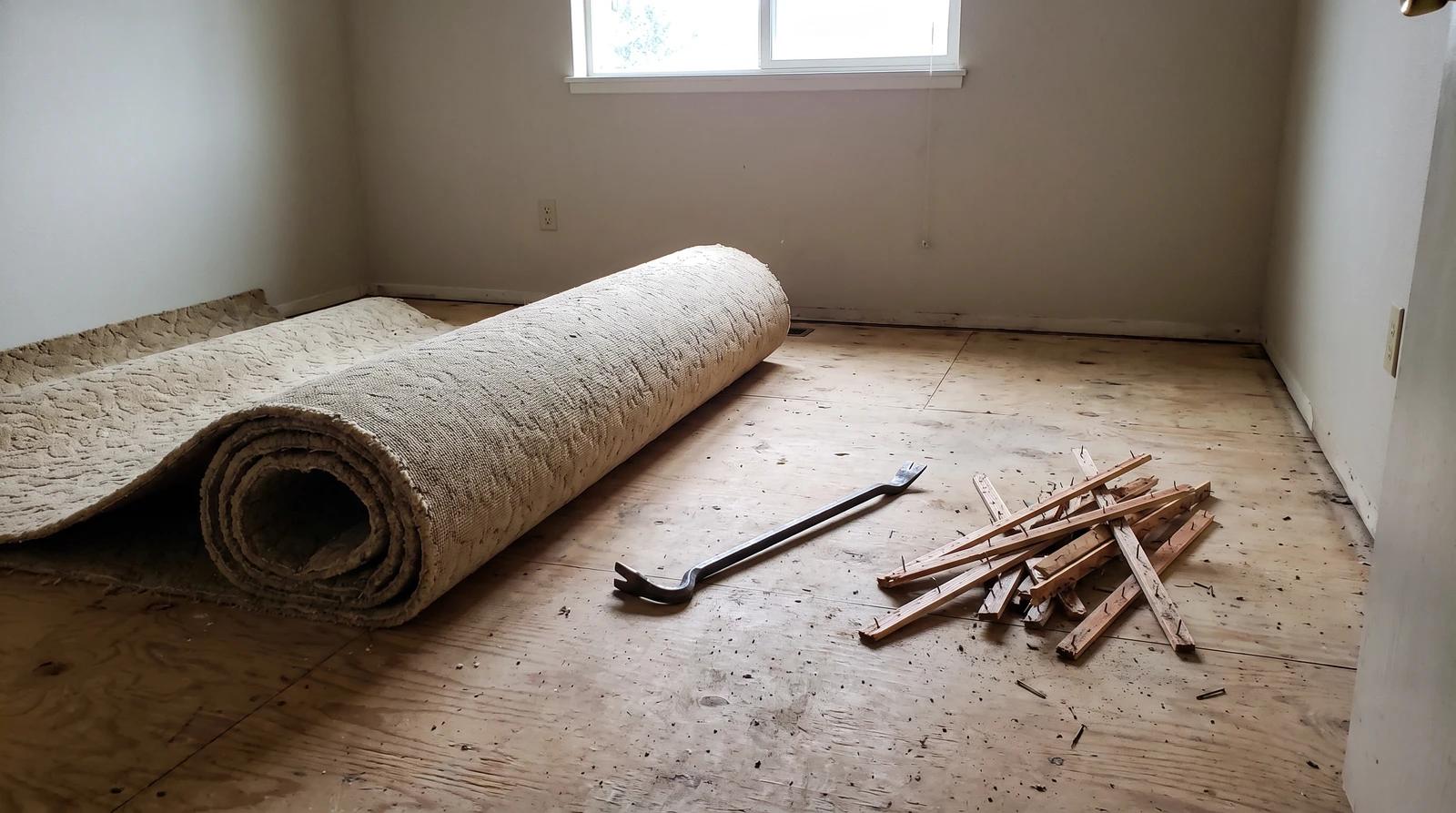
Labor Cost to Remove Carpet: The Work Behind It and How to Trim It
The labor cost to remove carpet comes down to how many hands-on steps the job needs and how hard each step is in your house: cutting and rolling the top layer, pulling the pad, clearing staples and edge nails, then carrying it all out.
A bedroom over plywood is straightforward work. Stairs, glue and crowded spaces are where the work grows, whether you're in Boise's North End, up on the Bench or out in Caldwell.
Most pages quote a carpet labor cost per square foot, but that average can't see your staircase or the glue in your basement. So here's the job broken into real steps, what you can do ahead of time to cut it down, and what the subfloor needs afterward.
What Goes Into the Labor Cost to Remove Carpet
It's really three jobs stacked together: getting the top layer up, getting everything under it up, and getting all of it out of the house.
Cutting and rolling it up
Wall-to-wall carpet is stretched tight and hooked onto rows of small nails around the edges. The first step is pulling a corner free and working it loose along the walls.
Then it gets cut into pieces narrow enough for one person to carry. Each piece is rolled and taped so it holds together on the way out. Dragging out one giant piece instead is how door frames and fresh paint get scuffed.
Those rolls are heavier than most people expect. Anything that's been soaked by a leak or a pet is heavier still, and a thick, plush carpet over a dense pad makes for heavier rolls, and more of them.
Pulling the pad, staples and tack strip
Underneath is the carpet padding, and on a wood subfloor it's usually held down with staples. The pad comes up fast. The staples don't. They're spread everywhere, and each one has to be pulled or driven flat.
Tack strip comes next. It's the thin wood piece with angled nails that runs along every wall, and it gets pried up a section at a time. This is the slowest, least exciting part of a carpet tear-out, and it's the part that decides whether the subfloor is actually ready for what goes down next.
Heads up: Those nails point up, and they're sharp. If you pull any yourself, wear heavy gloves and keep kids and pets away until every piece is gone.
Carrying it out and hauling it off
Once it's all up, the debris has to leave. Rolls and bags of pad go down the hall, out the door and onto the truck. A main-level bedroom with a short path to the driveway is easy. A second story, a tight staircase or a long condo hallway means more trips and more care with your walls.
Then there's disposal. Getting rid of old carpet costs a trip and a fee, whether it goes on a dump run to the local Ada County landfill or into a dumpster you rent. Much of what Boise Carpet Removal hauls is donated or recycled when it's in shape for it, so not every roll ends up buried.
How Hard Is the Tear-Out?
How hard it is to remove carpet depends mostly on what it's fastened to and where it sits.
Wall-to-wall carpet over a wood subfloor
This is the most common setup in bedrooms, hallways and living rooms, and it's the easiest. It's only held at the edges, so it comes up clean, and most of the time goes into pulling staples.
Stairs and landings
Stairs are slow. Every step is its own little project: carpet wrapped over the nose, stapled on the tread and the riser, nails on each one, and sometimes a separate piece of pad per step. Landings and turning stairs add odd-shaped cuts.
Hoping to refinish the wood under there? Say so before work starts. Pulling staples gently enough to protect a tread takes more care than a straight tear-out.
Glued-down carpet on concrete
Glue-down carpet shows up in basements, some condos and older homes. There's often no separate pad, just a foam or rubber backing stuck straight to the slab. It gets cut and pried up, and the backing tends to tear and leave patches behind.
What's left is adhesive and crumbled backing that has to be scraped. That scraping is hard, repetitive work, and it's the biggest reason glue-down takes longer than the stretched kind in the same size space.
| Situation | What adds time |
|---|---|
| Open bedroom, wood subfloor | Staples and edge nails |
| Stairs and landings | Cuts and fasteners on every step |
| Glue-down on concrete | Scraping adhesive and backing |
| Furnished or crowded space | Working around or moving contents |
| Upstairs or long carry | Extra trips with heavy rolls |
Is It Cheaper to Do It Yourself?
It can be, as long as your time is free and you have a way to get rid of it. One bedroom over plywood is a fair DIY project for someone with a utility knife, a pry bar, pliers, knee pads and good gloves.
Where doing it yourself loses its shine is disposal. Those heavy rolls don't fit in a car, and a dumpster rental, or a borrowed pickup and a dump run, both take money and time.
Prep you can handle before the crew shows up
Even if you hire it out, a little prep saves time and keeps the job moving:
- Clear everything out, including closets and under the beds.
- Lift out any vent covers.
- Clear a path to the door, and in winter, shovel and salt the walk.
- Put pets somewhere away from the work.
- Know what flooring is going in next, since that decides how clean the subfloor needs to be.
Worth asking: Is moving furniture part of the job, or should everything be cleared before the crew arrives? Contractors in your area handle it differently, and it's better to know when you book than on the morning of.
The parts most people are glad to hand off
Stairs, glue-down jobs and pulling staples across a whole house are the jobs people tend to regret taking on. So is carrying heavy rolls down a staircase and making the dump run. That's the core of residential carpet removal: everything comes up, and it leaves with the crew instead of sitting in your garage.
What to Do With the Floor Afterward
After removing carpet, check the bare floor for problems first, then get it flat, clean and dry for whatever flooring goes down next.
Check the subfloor for damage, stains and odor
On wood, look for dark stains, which usually mean pet urine or an old leak. Press near toilets, tubs and sliding doors to check for soft spots. If a smell lingers after the tear-out, it has likely soaked into the plywood and needs to be sealed or replaced before anything new goes down.
On concrete, look for cracks, damp spots and any glue left behind.
Quick tip: Take photos of the bare subfloor before anything new goes over it. If an installer or a future buyer ever asks what's under there, you'll have the answer.
Get it ready for wood, vinyl or laminate
Every staple needs to be out or flush, and everything swept and vacuumed. Vinyl shows every bump, so leftover adhesive on concrete needs to be scraped smooth. Laminate floats, which makes it more forgiving, but it still needs a flat base. Hardwood needs a solid subfloor that's fastened down well.
While it's open, screw down any squeaky spots. Then ask your installer two things before they show up: how flat the subfloor needs to be, and whether pulling up the old layer is part of their quote or they expect a bare, clean subfloor waiting for them.
Frequently Asked Questions
Is it better to have carpet in bedrooms?
It depends on what you want from the room. Carpet is warmer and quieter underfoot. Hard floors are easier to clean and hold less dust, which a lot of people with allergies prefer.
Is 20-year-old carpet unhealthy?
Not automatically, but carpet that old has usually soaked up a lot of dust, dander and grime deep in the fibers and pad. If it smells or someone in the house has allergies, it's a good time to pull it.
Does the price include hauling it away?
Not always, so ask. With us, haul-off is part of the job, so you don't need a dumpster or a dump run, and the firm price from the on-site estimate covers it with no hidden fees.
Can an online calculator give me a real number?
A calculator multiplies your sq ft by an average removal rate to give a rough removal cost, but it can't see stairs, glue, furniture, a long carry or what hauling looks like in your area. Those are what move the real number.
Getting a Firm Price on Carpet Removal
Related reading: How to Remove Carpet Without Cutting It and Keep It in One Piece and How to Remove Carpet Without Removing Baseboards, and Where It All Goes.
Most of the work hides in the details: staples, stairs, glue and the long carry out. A free on-site estimate turns all of that into one firm price before anything gets touched, so you're not guessing from an online average. If you're in Boise, Meridian, Eagle, Nampa or anywhere else in the Treasure Valley and want a local carpet removal service to take a look, call Boise Carpet Removal at (208) 314-4315.
Want us to handle it?
(208) 314-4315More From Our Blog
How to Remove Carpet Gripper From Wood or Concrete Without Gouging It
How to remove carpet gripper from a wood subfloor or concrete slab: where to pry, what to do with leftover nails, and how to bundle old strips safely.
How to Get Rid of Old Carpet: Trash, Recycling or a Removal Crew
How to get rid of old carpet: when your trash bin works, when your installer should haul it, and what a removal crew pulls, hauls, donates or recycles.
How to Remove Glued Carpet and Where All of It Goes Afterward
How to remove glued carpet with the end in mind: cut it, pull it, scrape the glue, then sort what can be donated, recycled or hauled to the landfill.
