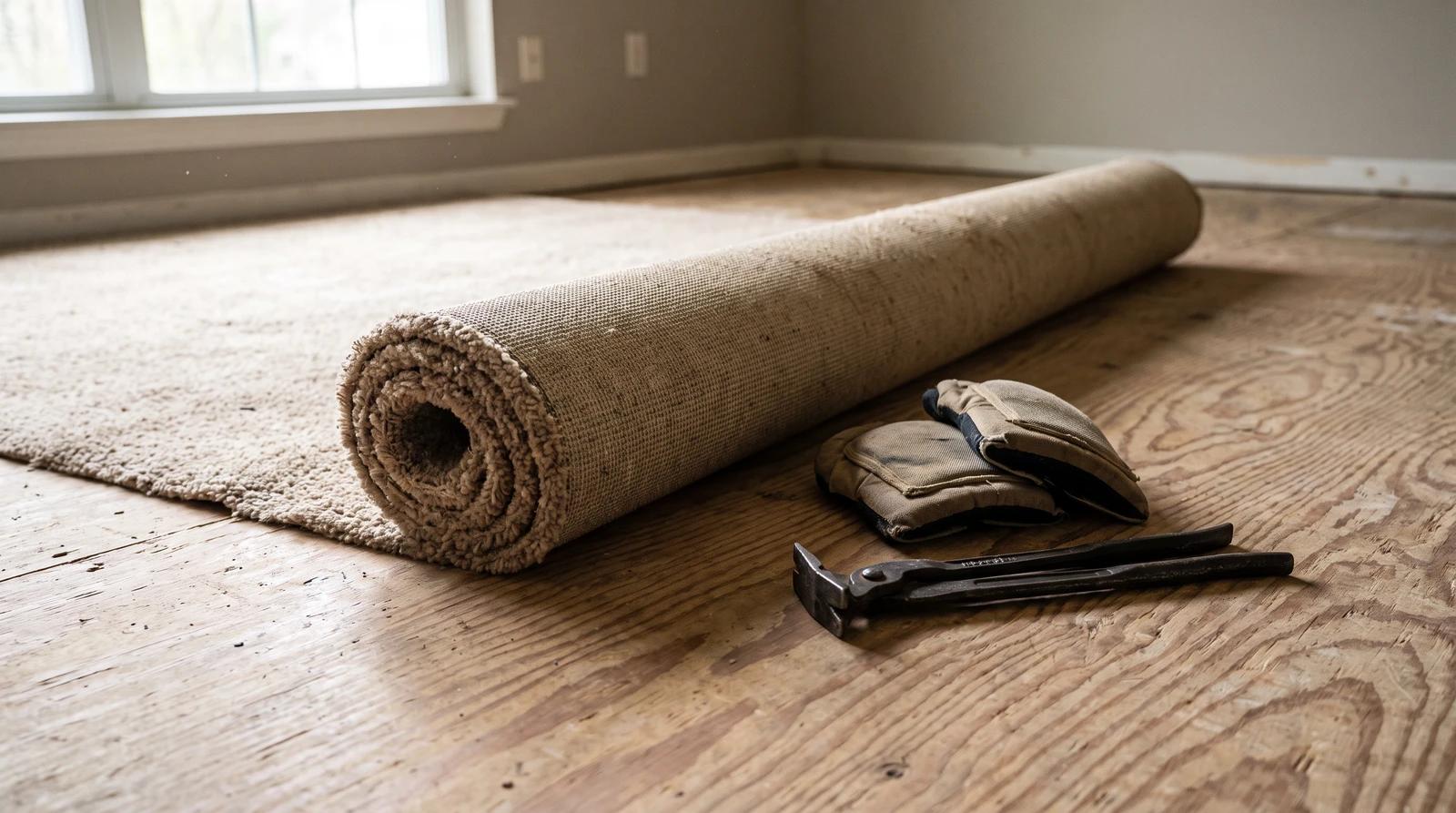
How to Remove Carpet Without Cutting It and Keep It in One Piece
Knowing how to remove carpet without cutting comes down to one method: free one corner from the nails along the wall, work every edge loose, then fold it back and roll it tight, face in, so the whole piece comes up in one length.
It takes more patience than slicing it into sections, and it's harder on your knees.
How easy it is depends mostly on the room size, the age of the backing and how many doorways and closets you have to work around.
How to remove carpet without cutting it
The short version: lift a corner, free the edges, peel it off the pad and roll as you go. Before any of that, get the furniture out so you have room to work.
Gear up: knee pads, gloves and nail puller pliers
You'll spend most of this job on the floor, so start with a good pair of knee pads. Add heavy work gloves, because the strip along each wall is lined with tiny upturned tacks, and they will find your hands.
These removal tools make it easier:
- Nail puller pliers to grab the first corner
- A carpet puller, if you have one, for a better grip on thick pile
- A flat pry bar for stubborn edges and metal thresholds
- Duct tape to hold the roll shut
Wear a dust mask too. Old carpet and carpet padding trap years of dirt, and it all comes up at once.
Start at a corner and lift it off the tack strip
Pick a spot away from the door, then pull back one corner right at the wall. Use pliers to grab it and pull up and toward the middle of the room. You'll feel the nails let go.
Once a few inches are free, switch to your hands. Steady carpet pulling works better than yanking. A hard jerk can tear the backing, especially on an older roll that's gone brittle.
Quick tip: Carpet in a cold room is stiffer and more likely to crack along the backing. If you're doing this during an Idaho winter, warm the house up first.
Work the edges free along each wall and doorway
Walk the edge along each wall, lifting it off the carpet tack as you go. Keep your pull low and close to the wall so the tacks let go cleanly instead of shredding the edge.
Doorways are where most people get stuck. The edge usually tucks under a metal or wood transition strip where it meets tile, vinyl or hardwood. Pry the strip up gently, or bend the metal lip back, and the edge slides free.
Free the closets before you start rolling, not after.
Fold it back, pull it off the pad and roll it tight
Once every edge is loose, fold it back on itself and peel it off the carpet pad. In most homes the pad isn't glued to the backing, so it lifts away as you pull it back.
Now roll it from one end, face in, keeping it tight and straight. Face in protects the pile and puts the tough backing on the outside. If the roll keeps springing open, wrap it with tape in a few spots.
A full room in one roll is heavy and awkward. Get a second person on the other end when you carry it out, especially on stairs or around corners.
Is it worth keeping it in one piece?
Keeping it whole is worth it only when that roll has a second life waiting. If it's headed for disposal anyway, cutting it into sections is faster and much easier to carry.
When a whole roll pays off
A whole roll makes sense when:
- You're moving it to another room, a basement or a shop where it will fit
- You want it bound into an area rug
- It's clean and in good shape, so someone else could use it
When to cut instead: wet, stained or pet-soaked rolls
Wet carpet is heavy, and the bigger the piece, the worse it gets. If a basement flooded or a water heater let go, cut it down and get it out so the subfloor can dry.
Pet-soaked rolls are the same story. The smell usually goes through the pile, into the carpet padding and sometimes into the subfloor. Nobody wants that roll, so save your back and cut it.
Heads up: If you see dark spots or smell something musty when you lift that first corner, look at the pad and subfloor before going further. Mold underneath is a bigger problem than the carpet itself.
Will a full roll fit down the hall?
Before you roll a big living room in one piece, walk the path out. Tight hallways, corners, stairs and narrow doorways are where full rolls get stuck.
A long roll that won't bend around a corner gets cut anyway, usually halfway down the hall. Better to decide that before you start.
What's the best way to cut through carpet?
The best way is from the back side with a sharp utility knife, in sections narrow enough to roll and carry. Flip a section over so the backing faces up. It gives you a clean line to follow, and the blade won't snag the pile.
If that's all you have, use a box cutter with a fresh blade. Change blades often, because a dull one takes more force, and that's how people slip. Never cut toward your other hand or your knees.
Cut pieces you can lift on your own, then roll and tape each one.
Good to know: A whole room of carpet and pad is more than a curbside bin will take. It's bulky construction waste, so most DIY jobs end with a dump run to the Ada County landfill or a Canyon County site. Check their current hours and rules before you load up.
Cutting out one damaged piece
If you only need to remove one ruined section, you don't have to pull the whole room, and you don't need any special tools. Free that area from the wall edge, then use a box cutter or utility knife and a straightedge to cut out the bad part from the back. Whoever patches it will need a clean, square edge.
What to do with the floor after the carpet comes up
Pull the pad and staples, decide about the strips along the walls, then check the subfloor before new flooring goes down.
Pull the pad and the staples
On a wood subfloor, the carpet pad is usually stapled down. Cut it into sections, peel it up, then go back for the carpet staples. Most staples remove cleanly with a flat scraper or a stiff putty knife.
One stray staple can show through vinyl or squeak under laminate. On concrete, the pad is often glued instead, so plan on scraping.
Tack strip: take it out or leave it?
Tack strips are thin wood nail strips with the points angled toward the wall. Leave them if new carpet is going back in and they're solid. Pull them if you're putting down hard flooring or they're rusted, rotted or loose.
To remove tack strip, slide a pry bar under it near each nail and lift. Go slow near the baseboards. Bag the pieces right away, because those nails point up.
Plywood vs. concrete: what to check first
On plywood or OSB, look for soft spots, water stains, squeaks and raised nail heads. A soft spot near a bathroom or slider door usually means old water damage that needs fixing first.
On concrete, check for cracks, damp spots and leftover glue. Either way, new flooring needs a clean, flat, dry floor, so finish with a good vacuum.
Frequently asked questions
Can you pull up carpet yourself?
Yes, as long as you have gloves, knee pads, nail puller pliers, a scraper and some patience. The hard parts are the weight, the nails along the walls and hauling it all away.
Do you have to take off baseboards first?
No. The edge tucks under the baseboard but isn't attached to it, so it pulls out without touching the trim. Baseboards usually only come off when new hard floors need to slide under them.
Which rooms are better off without it?
Bathrooms, kitchens, laundry rooms and entryways. Anywhere that gets wet or tracks in a lot of dirt is hard on carpet and its pad.
How much does it cost to have it pulled up?
It depends on room size, stairs and closets, whether the pad is glued down, how tight the path out of the house is, and disposal. It takes longer to remove carpeted stairs than open rooms, and wet carpet weighs more, so the only way to get a real number is an on-site look.
So, roll it or cut it?
Pulling it up whole is very doable with patience and the right tools. Just decide first whether that roll has somewhere to go. If it doesn't, cut it and spare yourself the heavy lifting.
The Residential Carpet Removal page covers what the service includes and how the estimate works.
Related reading: How to Remove Carpet Without Removing Baseboards (and Keep Them Clean) and How to Pull Up Wall to Wall Carpet Without Damaging What's Under It.
Would you rather skip the whole thing? We pull up carpet across Boise, Meridian, Nampa and the rest of the Treasure Valley, and we donate or recycle what we can. Give us a call at (208) 314-4315 for a free on-site estimate with a firm price before anything gets touched.
Want us to handle it?
(208) 314-4315More From Our Blog
How to Remove Carpet Gripper From Wood or Concrete Without Gouging It
How to remove carpet gripper from a wood subfloor or concrete slab: where to pry, what to do with leftover nails, and how to bundle old strips safely.
How to Get Rid of Old Carpet: Trash, Recycling or a Removal Crew
How to get rid of old carpet: when your trash bin works, when your installer should haul it, and what a removal crew pulls, hauls, donates or recycles.
How to Remove Glued Carpet and Where All of It Goes Afterward
How to remove glued carpet with the end in mind: cut it, pull it, scrape the glue, then sort what can be donated, recycled or hauled to the landfill.
