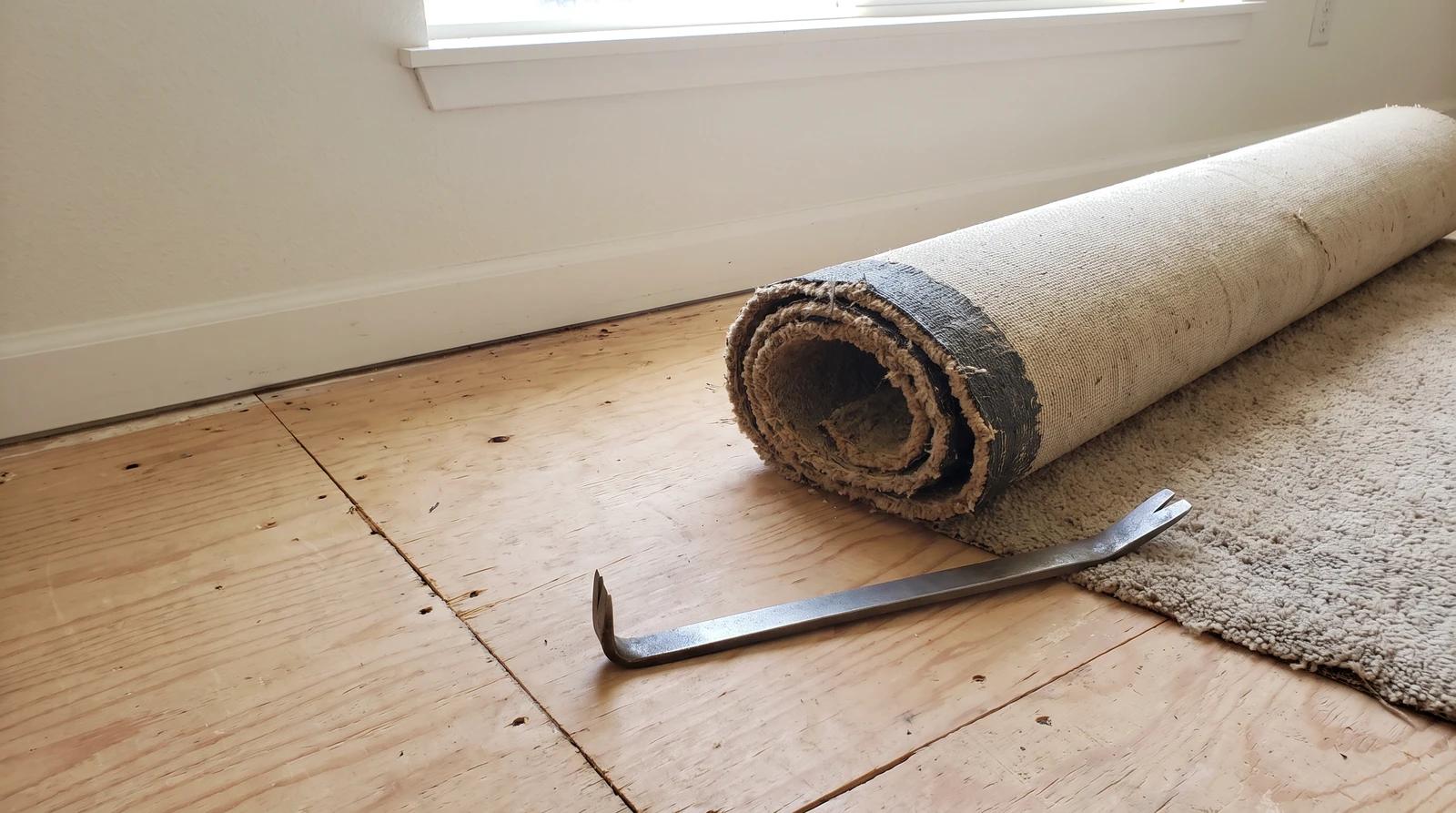
How to Remove Carpet Without Removing Baseboards, and Where It All Goes
Learning how to remove carpet without removing baseboards mostly takes patience along the wall edge. The carpet hooks onto a strip set just off the wall, not under the trim, so it can come up while the trim stays put. The part most people don't plan for is where everything goes once it's up.
One room leaves you with heavy rolls of carpet, a pile of pad, wood strips covered in sharp pins and a can full of staples. Each of those goes somewhere different.
A lot of tear-out material can be donated or recycled, but only when it comes up in decent shape and gets sorted on the way out. So this guide covers both jobs: getting the old floor out with the trim left alone, and sending each piece somewhere sensible.
Do you need to take the trim off first?
Usually not. Carpet doesn't run under the trim. The edge hooks onto a tack strip nailed down a little way off the wall, then gets tucked into the gap between that strip and the trim. Unhook it and it comes away while the trim stays on the wall.
Prying the trim off and putting it back means filling nail holes, recaulking and touching up paint, and it rarely sits quite the same the second time. Leaving it alone also means one less pile of debris, since cracked or split trim usually can't be reused.
Good to know: Older homes in places like the North End and the Bench sometimes have old sheet vinyl or tile under the pad. Leave it in place until it's been tested. Some older flooring contains asbestos, and it can't just go out with the rest.
When taking off the trim makes sense
Leaving the trim in place is where you start, not a rule. Taking it off is worth it when the boards are cracked, loose or water-stained, when you're replacing them anyway, or when the new floor is too thick to fit under what you have.
LVP and laminate need a small expansion gap at the wall, and either the trim or a thin quarter round has to cover it. Nail-down hardwood or tile on backer board adds even more height. Ask your flooring installer what they plan to do before tear-out day, so the removal crew knows whether to protect the trim or take it off.
If new trim is going in anyway, taking the old boards off before the floor comes up can make the work a little easier, since there's nothing left to protect.
Worth asking: If the trim is coming off, is it going back up? Boards you plan to reuse have to come off gently and get labeled by wall. Trim you're replacing can go straight on the debris pile.
How to remove carpet without removing baseboards
Clear the room, put on heavy gloves and knee pads, and set up three spots before you start: one for the rolls, one for pad and one for anything with metal in it. A corner of the garage, a tarp in the driveway or a few heavy contractor bags will do. Sorting now is a lot easier than picking staples out of foam later.
1. Score the seam along the trim
Years of paint and caulk can glue the carpet edge to the bottom of the trim. Run a sharp utility knife along that seam, keeping the blade low and flat, so the paint stays on the trim when the edge lifts.
2. Pull the edge back from the wall
Start in a corner. Grab the edge with locking pliers, lift it off the pins, then fold it back toward the middle of the room. Lifting straight up drags the stiff backing across the face of the trim, and that's how a lot of scuffs happen.
If a section fights you, work a little at a time along the wall instead of yanking on one spot.
3. Cut it from the back and roll it clean
Flip the loose section over and cut it into strips one person can carry. The blade runs straighter on the backing side, and you're less likely to cut into the subfloor.
This is the step that decides whether the carpet can be donated. If it's clean, dry and free of pet stains or odor, roll it tight with the face side in and tape it shut. Worn, stained or damp pieces go on the disposal pile, so don't bother being careful with them.
4. Lift the pad on its own
The carpet pad is usually stapled to the subfloor, so it peels up in sections. Keep it in its own pile, away from the rolls. Clean foam pad is one of the more recyclable parts of a tear-out, since rebond pad is made from scrap foam in the first place. Wet or moldy pad is the exception. Bag it for the landfill.
5. Take out the tack strip with a nail puller
This is where trim usually gets hurt. Slide a flat pry bar under the strip and lever against the floor, not the wall. If you're working tight to the trim, put a thin scrap of wood behind the bar to spread the pressure. Take the strip out in short pieces.
Then pull the leftover carpet staples with pliers, and tap any snapped ones flat. Put strips and staples straight into a sturdy box or bucket, not a thin trash bag. The pins tear right through plastic and stab whoever carries it next.
Where does the old carpet go once it's up?
Here's an easy way to sort the pile once the room is bare:
| Material | Where it can go | How to prep it |
|---|---|---|
| Carpet in good shape | Donation or reuse | Clean, dry, rolled tight and taped |
| Stained or damp pieces | Landfill | Rolled and taped so they're easy to lift |
| Pad | Recycling if clean and dry, landfill if not | Kept separate, bagged or rolled |
| Strips and staples | Landfill or scrap, depending on what's accepted | Boxed so the pins can't poke through |
| Old sheet vinyl or tile | Hold until it's tested | Left in place |
What donation spots and recyclers take changes over time. It depends on the fiber, the condition and how much room they have. Call ahead before you load the car.
Around the Treasure Valley, a room's worth of old flooring won't fit in most trash cans, so check what your city's curbside service accepts before you stack rolls at the curb. Bulky loads usually mean a drop-off run. In Boise and the rest of Ada County, that's the county landfill. Nampa, Caldwell and Middleton are in Canyon County, which runs its own site. Each site sets its own rules on what it accepts, how loads must be covered and what it charges, so check their current hours and rules before you go.
A few local things change how that trip goes:
- Summer heat: Rolls sitting in a hot garage or truck bed hold smells and shed fibers. Get them out fast.
- Winter cold: Wet rolls and pad left outside can freeze into stiff, heavy lumps.
- Spring cleanouts: Drop-off sites can get busier when everyone is clearing out garages at once.
- Covered loads: Loose foam blows out of an open truck bed quickly at highway speed. Tie it down.
Quick tip: Old flooring and pad are bulky more than they're heavy. A single room can take up more space in a vehicle than you'd expect, so plan your trips around volume.
Frequently asked questions
What tool can I use to pull up carpet?
A utility knife, locking pliers or a carpet puller, a flat pry bar, a staple remover, heavy gloves and knee pads will handle most rooms.
Can old carpet be donated?
Sometimes. Pieces that are clean, dry, odor-free and usable have a chance, but every place sets its own rules, so call before you haul them over.
Is the pad recyclable?
Clean, dry foam pad often is. Wet, moldy or badly soiled pad usually isn't.
Can you put in LVP without removing the trim?
Often, yes. It comes down to how thick the new floor is and whether its edge can be hidden under the trim or behind quarter round. Your installer can tell you which way it'll go.
Before you start
Some things slow a tear-out down: pad that's glued instead of stapled, stairs where every step has its own strip and staples, furniture still in the room, and edges painted to the trim. Plan for those, and decide where everything is going before the first piece comes up.
If you want the trim to come through without a single ding, take your time on the edges and the strips.
The Residential Carpet Removal page covers what the service includes and how the estimate works.
Related reading: How to Remove Carpet Without Cutting It and Keep It in One Piece and How to Pull Up Wall to Wall Carpet Without Damaging What's Under It.
If you'd rather skip the hauling and sorting, Boise Carpet Removal handles carpet and flooring removal in Boise, Meridian, Nampa, Caldwell, Eagle, Kuna and the rest of the Treasure Valley. The on-site estimate is free, and you get a firm price based on the space and the work involved before anything is touched. There are no hidden fees, same-day service is available when the schedule allows, and you can pay by cash, card or Venmo.
Want us to handle it?
(208) 314-4315More From Our Blog
How to Remove Carpet Gripper From Wood or Concrete Without Gouging It
How to remove carpet gripper from a wood subfloor or concrete slab: where to pry, what to do with leftover nails, and how to bundle old strips safely.
How to Get Rid of Old Carpet: Trash, Recycling or a Removal Crew
How to get rid of old carpet: when your trash bin works, when your installer should haul it, and what a removal crew pulls, hauls, donates or recycles.
How to Remove Glued Carpet and Where All of It Goes Afterward
How to remove glued carpet with the end in mind: cut it, pull it, scrape the glue, then sort what can be donated, recycled or hauled to the landfill.
