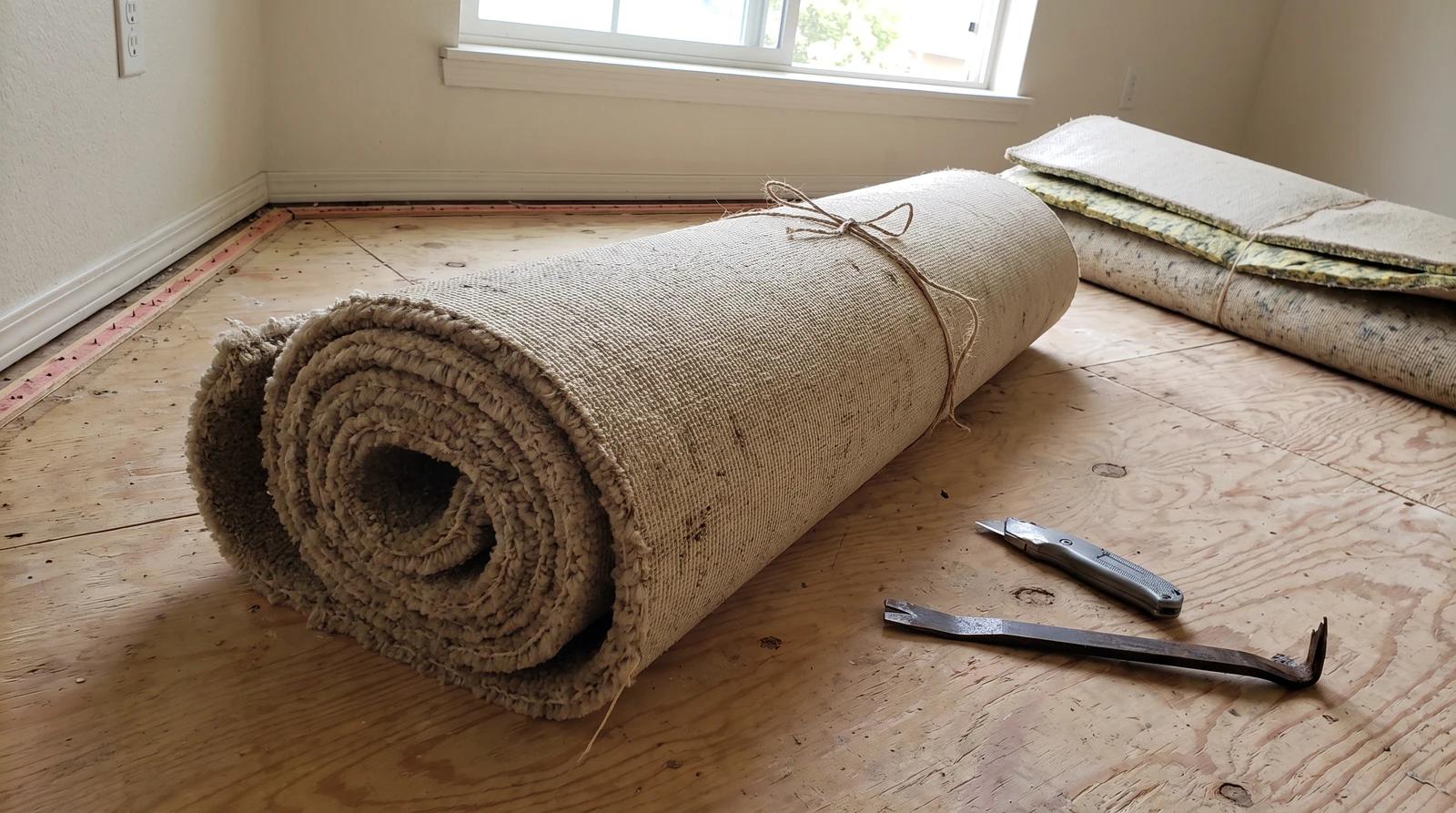
Is It Cheaper to Remove Carpet Yourself? What the DIY Bill Includes
The short answer to "is it cheaper to remove carpet yourself" is yes, on labor alone. Then add the tools, a way to haul heavy rolls of carpet and pad, disposal, and the leftover tack strip and staples. The gap can get a lot smaller than you might expect.
For a small room with an easy carry-out, the DIY route is much cheaper. For stairs, glued-down carpet or a whole house, a professional crew may cost less, or come close enough that it isn't worth your weekend.
Below is the DIY bill line by line, next to what a crew's firm on-site price already covers, so a homeowner in the North End, Meridian, Nampa or Caldwell can compare the same work on both sides.
Is it cheaper to remove carpet yourself once everything is counted?
DIY saves the most when you already own the tools, have a truck or trailer and don't mind giving up a weekend. If you're buying, renting or borrowing all of that, the savings shrink fast.
Tools and supplies you'll need to buy or borrow
Even a cheap tear-out takes a small kit:
- A utility knife and plenty of extra blades, since carpet backing dulls them quickly
- A flat pry bar and a hammer
- Pliers or end nippers for staples
- A flat scraper to remove pad and foam stuck to the subfloor
- Heavy gloves, knee pads and a dust mask
- Duct tape or twine for the rolls, plus heavy contractor bags
None of these is expensive alone. Added up, they're often the first surprise on the DIY bill.
Getting everything out and disposed of
This is the line people forget. Carpet from a single bedroom rolls up heavy and awkward. The pad turns into a pile of bulky foam that's hard to fit in a trash cart.
You'll need a truck or trailer, straps to hold it down, and a trip to a landfill or transfer station. Disposal fees depend on the weight and type of load. The Ada County and Canyon County landfills each set their own rules, so check before you load up.
Heads up: A full room of carpet and pad is often treated as bulky waste, not regular trash. Call your hauler before setting rolls at the curb, or you may be loading them back up.
Your time, your back, and the install date you're working toward
Your time counts too. Cutting, rolling, hauling and pulling staples is a slow process done mostly on your knees. It's even tougher in an upstairs bedroom during a hot Boise summer.
The bigger risk is the schedule. Your installer may be booked for a set day. If the old carpet, pad and staples aren't fully gone by then, you may have to reschedule.
How much does it cost to clear out one room?
The cost for one room comes down to a handful of factors: its size, how the carpet is attached, what's in the way, and disposal. Boise Carpet Removal prices by the space and the work involved. So two spaces that measure the same can still land in different places.
The cost tends to stay on the low side for an empty bedroom of average size with stretched-in carpet. It climbs with stairs, glue and long carries.
Room size, closets and stairs
More area means more carpet, more pad and more staples to pull. Closets are a small area, but they add cuts and corners.
Stairs are often the slowest area in a home to clear. Every tread and riser is cut, pried and cleaned by hand. The carpet often wraps the nose of each step, too.
Stretched-in vs. glued-down carpet
Most carpet in homes is stretched over tack strips with a pad underneath. It pulls up fairly cleanly. Glued-down carpet shows up more in basements and some older homes, and it has to be scraped off the concrete. That's slower, messier work. The adhesive left behind also affects what can go down next.
In older homes, if you find old vinyl tile or dark, tar-like adhesive under glued carpet, stop before you scrape. Some older flooring materials contain asbestos. Have them tested by a professional first.
Worth asking: Not sure how yours is installed? Ask whoever gives you a price to lift a corner in a closet. Glue changes the work more than almost anything else.
Furniture, access and how far it has to be carried
Empty rooms go faster. An upstairs bedroom with a narrow stairwell, a long walk to the driveway, or a condo with shared hallways all add carrying time.
Furniture that has to be moved off the carpet and put back is part of the job too, so mention it up front.
Disposal: what gets donated, recycled or hauled
Not every piece has to end up in the landfill. Clean pad is often easier to recycle than the carpet itself. Pieces in good shape can sometimes be reused.
Boise Carpet Removal donates or recycles much of what it hauls and takes the rest to the right drop-off. Doing it yourself, recycling means sorting and one more stop. If that matters to you, ask any crew where your old flooring will actually go.
Can you do it yourself? What the work really involves
Yes, and plenty of people do. The process is simple on paper. It's the volume, the kneeling and the cleanup that make it a real job.
This kind of tear-out generally doesn't need a permit on its own. If the project grows into demolition, check with your city's building department first.
Cutting it into strips you can actually lift
Before you start, clear the room and take off any doors that would drag on the carpet as you work. Then start in a corner and grab the carpet edge with pliers to pull it free of the pins along the wall. Fold it back. Then cut it into strips with your utility knife, working from the back side so you don't score the floor.
Roll each piece tight and tape it. Narrower rolls are easier on your back and easier to load.
Pulling the pad and every staple under it
Pad is usually stapled to wood subfloors. Once it's up, you'll find staples every few inches along the edges and seams. You'll need to remove each one.
On concrete, pad is sometimes glued, and the leftover foam has to be scraped. This is often one of the slowest parts of DIY removal, and it's the part people rush.
Quick tip: After you think you're done, drag a flat scraper across the whole subfloor. You'll catch the staples you missed before your installer does.
Deciding on the tack strip before the new floor goes in
Tack strips are the thin boards with sharp pins that run around the edge of the room. If new carpet is going back in, your installer may want to reuse the ones that are still solid.
If you're putting down hard flooring, every strip has to come out. The nail holes may need filling, too. Ask your installer before you pull anything. It's an easy thing to get backwards.
Loading it out and finding somewhere that will take it
Last comes the part nobody plans for. Rolls go out through your home, so protect door frames and fresh paint on the way.
Then they get strapped into a truck for the landfill or transfer station, which usually charges a drop-off fee. Spring cleanout season can mean longer lines at the gate, so check current hours and rules before you go.
Carpet removal FAQ
Is replacing carpet difficult?
Taking the old carpet out is the easier half. It's physical but simple. Installing the new one well takes stretching tools and practice, so many people hire a professional for that part even when they handle the tear-out.
What are the disadvantages of carpet flooring?
Carpet holds dust, pet hair and stains, and it wears down in traffic paths. It usually needs replacing sooner than hard flooring. It's also bulky and heavy to get rid of when it's done.
How much do you save by removing carpet yourself?
You save the labor, but you pick up tools, hauling, landfill charges and your time. The savings are biggest on a small, empty room with an easy carry-out. They're smallest on stairs, glued carpet or a whole house.
What's included when a crew does it for you?
With Boise Carpet Removal, the free on-site estimate gives you a firm price based on the space and the work involved, with no hidden fees. If you're comparing services, ask each one what its price covers.
Should you pull the carpet yourself or hire it out?
If you've got a truck, the tools and a free weekend, a small room is a fair DIY project. For stairs, glue, a whole floor or a tight install date, compare the full DIY bill against a firm price. That usually makes the answer clearer.
Related reading: Labor Cost to Remove Carpet: The Work Behind It and How to Trim It and How to Remove Carpet Without Cutting It and Keep It in One Piece.
Boise Carpet Removal's Residential Carpet Removal service starts with a free on-site estimate anywhere in the Treasure Valley, from Eagle and Star to Kuna and Canyon County. You'll get a firm price before anything is touched, and you can pay by cash, card or Venmo. Give us a call at (208) 314-4315 when you're ready to compare.
Want us to handle it?
(208) 314-4315More From Our Blog
How to Remove Carpet Gripper From Wood or Concrete Without Gouging It
How to remove carpet gripper from a wood subfloor or concrete slab: where to pry, what to do with leftover nails, and how to bundle old strips safely.
How to Get Rid of Old Carpet: Trash, Recycling or a Removal Crew
How to get rid of old carpet: when your trash bin works, when your installer should haul it, and what a removal crew pulls, hauls, donates or recycles.
How to Remove Glued Carpet and Where All of It Goes Afterward
How to remove glued carpet with the end in mind: cut it, pull it, scrape the glue, then sort what can be donated, recycled or hauled to the landfill.
