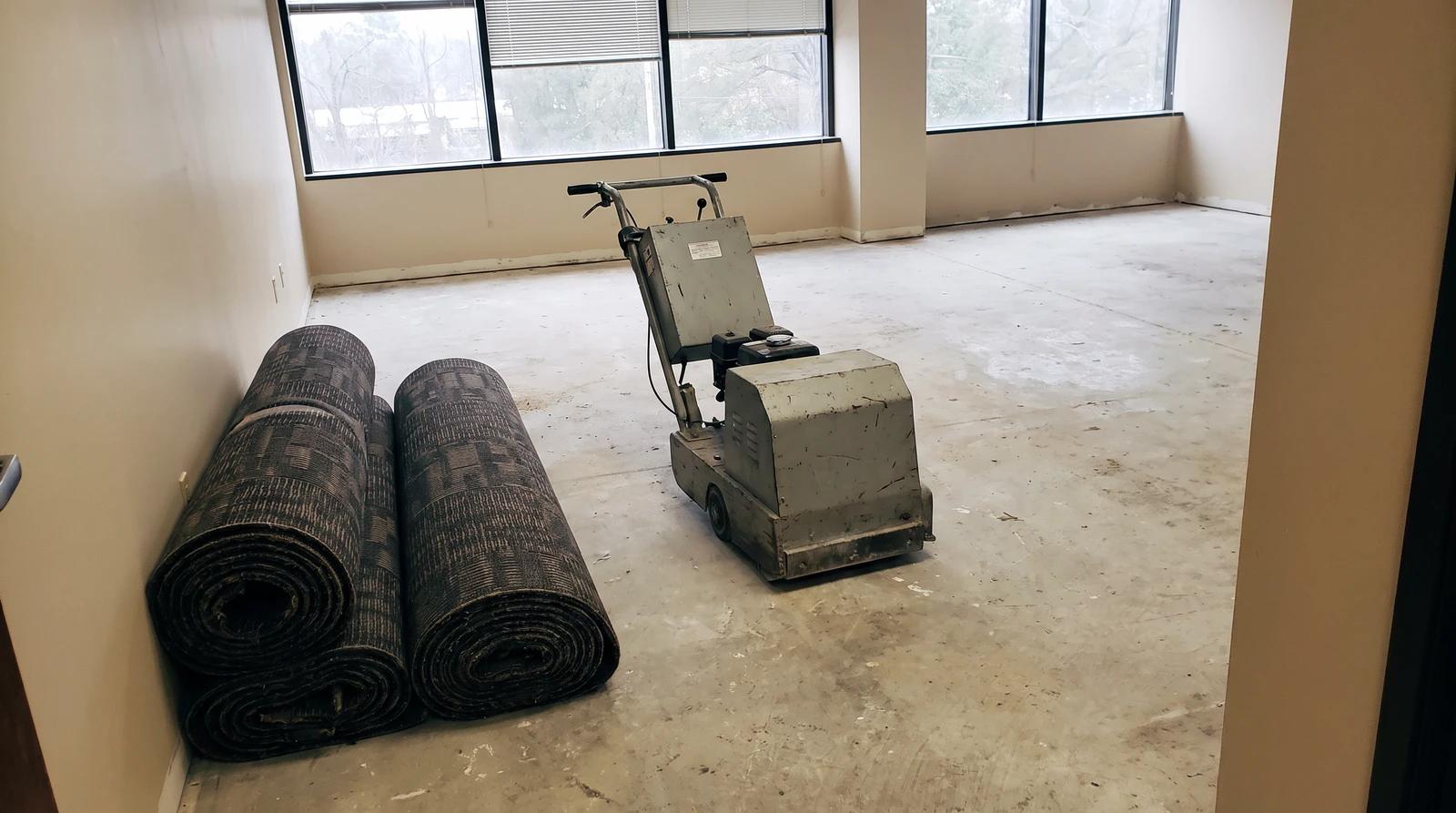
Commercial Carpet Removal Machine: What It Does and What It Leaves Behind
A commercial carpet removal machine is a heavy, weighted stripper that pushes a sharp blade under glued-down flooring and peels it off the slab in strips, so a crew doesn't have to scrape a whole floor by hand. It doesn't cut the strips, reach the edges, clean up the glue it leaves or haul a single roll to the dump. For an office, shop or clinic in the Treasure Valley, it's only one piece of the job.
What a commercial carpet removal machine does, and what it can't
It drives a flat blade between the backing and the concrete, and its weight keeps the blade pinned while the strip lifts. It's built for one kind of work, floor stripping. It'll take up direct-glued-down broadloom, vinyl, rubber flooring and a lot of other glued products.
The operator steers and feeds each strip into the blade. Soft adhesive lets a strip peel off in long runs, while old glue that's gone hard makes the stripper fight for every inch.
Floor stripping kicks up dust and old adhesive smell, so fans pointed out an open door help keep the air clear.
Walk-behind, ride-on and battery-powered models
Walk-behind strippers are a common choice for glued-down floors. Self-propelled models pull themselves forward, so you just guide them. Many are electric and plug into a wall outlet. On some models the unit automatically locks in place when you let go of the handle.
A portable stripper is small enough for a freight elevator or a standard door. Ride-on units are bigger, built for wide open floors like warehouses and gyms. Some have a seat switch, so the drive automatically locks when the operator stands up.
Then there are self-contained and battery-powered models, which skip the cord that electric units need. Every manufacturer builds its units a little differently, so check the manufacturer's blade guide for your glue. Some crews use a puller instead, which winches the strips up rather than shearing under them.
Why it gets cut into strips first
Before the stripper starts, everything gets cut into strips a little narrower than the blade, using utility knives or a power cutter in long, straight lines.
Why bother? The blade can get all the way under a narrow strip, so it comes up clean. A strip that's too wide stays glued at the edges and the blade bogs down. Narrow strips also roll tighter and weigh less for the carry-out.
Heads up: A floor box or a bolt sticking out of the slab can chip a blade or gouge the concrete. Mark anything that sticks up before you start.
Spots it can't reach: edges, doorways, columns and stairs
A stripper works in straight lines on open floor. It can't get tight against a wall, under a built-in counter, around a column or through a narrow doorway at an angle. Those spots get hand scrapers.
Stairs are all hand work. So are small closets, restrooms and any room too tight to turn around in.
Renting a stripper vs. hiring a crew
Renting gets you a stripper. Hiring a crew gets you the whole job, start to finish.
What a rental includes, and what it doesn't
A rental usually means the stripper and a blade. Spare blades and parts, plus a way to get it to the job, are often on you, and the bigger units take more than one person to load.
An electric stripper also needs a working outlet close by, and so do any fans you run for the dust. If the power's been shut off, ask the rental shop about self-contained and battery-powered models.
Expect a learning curve, too. Your first stretch on an unfamiliar stripper will be the slowest.
Unless you strip floors often, buying one, new or used, is a lot to spend on one floor.
What's left after the stripping: rolling, carrying and hauling
Once the slab is bare, someone still has to handle:
- Rolling and taping every strip
- Pulling up the pads if it was double-glued over a cushion
- Carrying it all out, down stairs or through a lobby that's still open
- Loading a trailer or dumpster
- Driving it to a donation spot, a recycler or the landfill
Glued rolls are heavy and dusty, and a big office floor fills a trailer quickly.
Where the old rolls go: donation, recycling and the landfill
We sort what comes out, and much of what we haul is donated or recycled. Glued broadloom is harder to reuse. It comes up torn and coated in adhesive, so a lot of it ends up at the Ada County or Canyon County landfill.
If you'd rather hand off the whole thing, a removal crew can quote the cutting, edge work, loading and hauling together.
How much does it cost to remove a glued-down floor?
The cost comes down to the glue, the backing, the floor size, access and disposal. Two floors the same size can be very different jobs, so we don't post a flat rate.
What the glue and the backing do to the time
Modular squares on release adhesive pop up easily. Full-spread glue is slower, and glue that's gone hard is slower still. With a double-glue install, the top layer is glued to a cushion that's glued to the slab, so there are two layers to strip.
The backing matters too. Some backings peel off cleanly. Others tear and leave a layer stuck in the glue, which means more scraping.
Square footage, furniture, access and business hours
More square footage means more strips, rolls and trips to the truck. Cubicles, shelving and desks have to be moved first. Upper floors, small elevators, no loading dock and tight downtown parking all slow the carry-out.
If your business stays open, the floor can be done in sections so some of the space keeps running. A closed-up warehouse in a hot Boise summer needs fans going, and an icy dock in January makes loading slower.
Is the tear-out one step in a bigger demo, like walls or built-ins? Check with your city about permits. We can handle the permit application for demolition work.
Disposal, and why a firm price beats a guess
Disposal depends on weight and where the load goes. A phone quote can't see your glue, your backing or your stairwell.
That's why we do a free on-site estimate and give you a firm price before anything is touched. It's priced by the space and the work involved, with no hidden fees. Cash, card and Venmo all work.
Worth asking: Is scraping the glue ridges included, or does the crew leave that for your flooring installer? Get the answer before work starts so nobody's surprised.
How to clean a floor after the tear-out
To clean the slab, scrape the glue ridges, sweep and vacuum, then check it before the new flooring goes down.
Scrape the leftover glue ridges and loose backing
A stripper leaves glue ridges along the old trowel lines and scraps of backing. A long-handled floor scraper knocks most of it down. Ask your installer how flat the new flooring needs it.
Sweep, then vacuum the dust and fibers
Sweep the big debris first, then vacuum the fine dust and fibers with a shop vacuum. Point fans out a door, not across the room, or they'll just push the dust around.
Check the slab for cracks, moisture and old mastic
Look for cracks, low spots and damp areas. Moisture can stay hidden under old flooring for years. If a spot is damp, fans and time help, and your installer can test it properly.
Old black, tar-like mastic needs extra care. In older buildings it can contain asbestos, so get it tested before anyone sands, grinds or scrapes it hard.
Frequently asked questions
What's the easiest way to pull up a glued-down floor?
Cut it into strips narrower than your blade, then peel and scrape one strip at a time. On a big floor, a stripper does the lifting far faster than hand scraping.
What are the steps for clearing an office floor?
Clear the furniture, cut the strips, run a stripper down the open floor and hand-scrape the edges. Then roll and haul it all away, sweep the slab clean and run fans to clear the last of the dust.
What's the best tool for removing floor tiles?
A walk-behind or ride-on stripper with the right blade handles vinyl tile well. Ceramic set in mortar needs a heavier unit with a chisel-style blade, or a chipping hammer in small rooms.
Is it worth buying a used floor stripper?
Usually only if you strip floors often. A used one still needs spare blades, so for one office or shop, renting or hiring out tends to make more sense.
The Commercial Carpet Removal page covers what the service includes and how the estimate works.
Related reading: Commercial Carpet Tear Out: Lease Ends, Boise Business Guide and Commercial Carpet Removal in Boise: Old Tile and Black Mastic.
Related reading: Commercial Carpet Tear Out: Lease Ends, Boise Business Guide and Commercial Carpet Removal in Boise: Old Tile and Black Mastic.
For a free on-site estimate on the whole job anywhere from downtown Boise and the Bench to Meridian, Eagle, Nampa and Caldwell, give us a call at (208) 314-4315. There's no pressure either way.
Want us to handle it?
(208) 314-4315More From Our Blog
How to Remove Carpet Gripper From Wood or Concrete Without Gouging It
How to remove carpet gripper from a wood subfloor or concrete slab: where to pry, what to do with leftover nails, and how to bundle old strips safely.
How to Get Rid of Old Carpet: Trash, Recycling or a Removal Crew
How to get rid of old carpet: when your trash bin works, when your installer should haul it, and what a removal crew pulls, hauls, donates or recycles.
How to Remove Glued Carpet and Where All of It Goes Afterward
How to remove glued carpet with the end in mind: cut it, pull it, scrape the glue, then sort what can be donated, recycled or hauled to the landfill.
