How to Pull Up Wall to Wall Carpet Without Damaging What's Under It
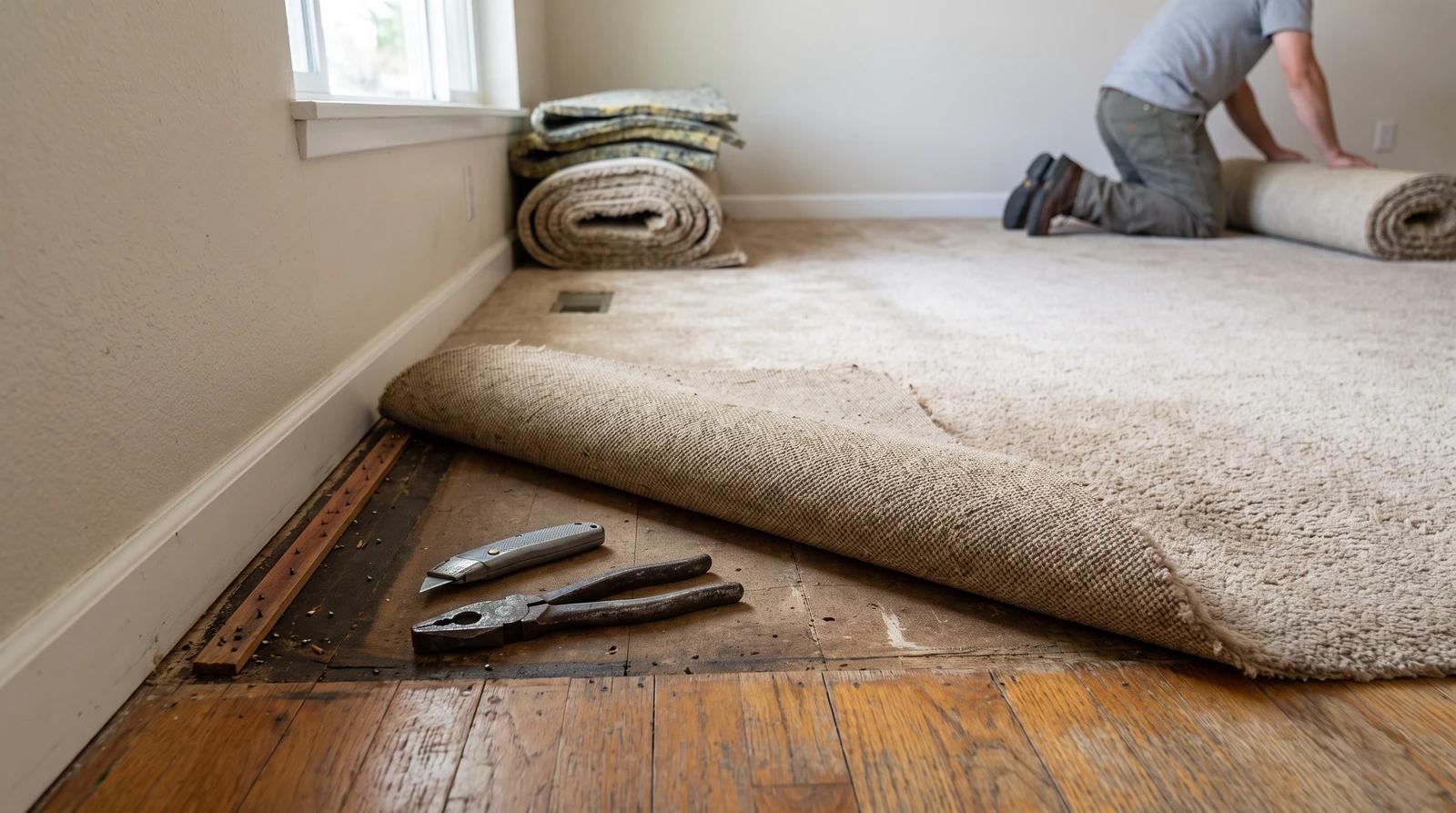
How to pull up wall to wall carpet comes down to one order of work: start in a corner, grip it with pliers, lift it off the strip, then cut it into strips you can roll up and carry out before you deal with the pad and staples underneath. The rest is about doing it without gouging the floor, cracking baseboards or bending trim.
Unlike an area rug, wall-to-wall carpeting is fastened to the floor, but in most homes it isn't glued down across the room. The carpet and padding are held in place in two layers: the top layer is stretched tight and hooked onto a strip of sharp pins around the perimeter, and the pad is stapled or glued below it. Once you release those edges, it mostly wants to come up, which is why plenty of homeowners take this on themselves. This is the order that works.
How to pull up wall to wall carpet: tools and steps
A DIY pull-up takes a few basic carpet tools and some patience along the baseboards. Here's what to have on hand:
- Work gloves and knee pads (those pins are sharp, and you'll be kneeling a lot)
- A utility knife or carpet knife with plenty of fresh blades
- Pliers or a puller
- A flat pry bar, like a molding removal bar, and a hammer
- A staple puller or flat-head screwdriver
- Duct tape, contractor bags and a shop vac
Clear the room and pull the doorway transitions first
Move everything out, closets included. If a door is in the way, take it off its hinges. You'll have more space to work, and it won't get scraped.
Next, handle the doorway transitions. Carpet usually tucks under a metal strip or a wood threshold where it meets tile, vinyl or hardwood. Gently pry up the lip or take out the fasteners holding it. If it's tucked in tight, cut back carpet right along the transition so it slides free. Yank carpet out from under a transition that's still fastened and you can bend the metal or chip the tile next to it.
Heads up: Don't brace your pry bar on the next room's hard floor. A bar resting on tile or laminate can crack it with less force than you'd think. Slip a scrap of wood under the bar first.
Start in a corner and free the edge
Pick a corner and grab it with pliers. Lift up and slightly toward the middle of the room. The pins on the strip angle toward the baseboard, so lifting away from it lets the backing slide off the toothed end instead of snagging.
Once that first spot is free, the carpet edges should peel off along the baseboard in a steady line. If a section fights you, change your angle instead of jamming the bar against the trim.
Cut it into strips so you can easily pull it out
This step saves your back. Fold the loose carpet over on itself and slice it from the back side with your knife, making strips a few feet wide. You're cutting through the backing instead of the pile, so it goes faster.
Roll each strip up tight and tape it. A whole room in one piece is heavy and awkward, especially down a hallway or stairs. Swap blades often, too. A dull blade slips, and slips are how people cut themselves on this job.
Pull the pad and clean up the staples
Carpet padding is usually stapled to a wood subfloor or glued in spots on concrete. Grab it, tug and bag it as you go. It tears easily.
What's left behind is the tedious part: a lot of staples. Work them out with a staple puller, or a screwdriver and pliers. Little bits of pad stuck under staples will show through new flooring, so get every one, then sweep and vacuum.
Decide whether the tack strips stay or go
If new carpet is going down, the strip can often stay as long as it's solid and not broken or water damaged. The installer will either reuse it or lay tack strip fresh along the walls.
If you're switching to hardwood, laminate, vinyl or tile, it all comes out. Slide your molding removal bar under the strip next to each nail and lift slowly. Place the scraps in a box, not a bag. Those pins tear right through plastic.
What makes wall-to-wall carpet buckle?
It buckles when it loses the tension that keeps it flat. Installers use a carpet stretcher, the powered kind that braces against the opposite wall, to draw it tight before hooking it on the strip. If it was only pushed in with a knee kicker, or the strip was loose, it can relax and ripple. Dragging heavy furniture, a pad that's breaking down and the swings between our dry summers and freezing winters can all make it worse.
Why does that matter when you're pulling it up? Rippled carpet is already loose, so you can often easily pull it right off the strip. But the pad under older, rippled carpet tends to crumble as you go, which makes for more sweeping.
Protecting the baseboards and the floor underneath
In nearly every room, the baseboards can stay on. Carpet goes in after the trim, tucked into the gap between the strip and the baseboard. You're lifting it back out of that gap, not out from under the trim.
Working along baseboards and door casings
Keep the pry bar off the face of the baseboard. If you need leverage, work against the room side of the strip. Paint often bridges from the baseboard onto the pile, so run a utility knife along that seam first so the paint doesn't peel off with it.
The casings around each opening are thin and split easily. Cut back carpet around each one rather than yanking it out from underneath.
If there's hardwood underneath
In older homes in the North End and on the Bench, carpet sometimes turns out to be sitting on original hardwood. If you want to keep it, take your time.
- Take staples out one by one instead of scraping the pad off.
- Lift the strip with the bar on top of a putty knife or thin shim so it never digs into the wood.
- Expect small pin holes along the baseboards. They usually fill and sand out when the floor is refinished.
Good to know: Before you plan a refinish, check the closets. They can tell you whether the hardwood runs through the whole house or stops at a patched section.
If it's a concrete slab
Basements and slab homes put carpet right on concrete. Here the strip and padding are held down differently: the strip with hardened masonry fasteners, the pad with spots of glue. Those fasteners can pop out a chip of concrete when they let go. That's fine if your installer will lay tack strip again, but fill bigger chips before a floating floor goes down.
A floor scraper takes care of leftover foam and adhesive. Old black adhesive can contain asbestos, so don't sand or grind it until you know what it is.
Frequently asked questions
How much does removal cost?
It depends on the square footage, stairs, number of rooms, glue on concrete and how much staple and strip work there is. If you're having wall to wall carpets pulled throughout the house, a free on-site estimate gives you a price before any work starts.
How often does wall-to-wall need replacing?
Replace it when the traffic paths are matted, it holds odors after cleaning, or it ripples again after being stretched. Pets, kids, foot traffic and quality all change how long it lasts.
Is wall-to-wall outdated?
Not really. Lots of people want hardwood or tile in living areas and kitchens, but it's still common in bedrooms and basements because it's warm and quiet.
Is it better to have hard floors in bedrooms?
It's mostly personal. Carpet is warmer on a cold Idaho morning and cuts down on noise, while hard floors are easier to keep clean if someone in the house has allergies.
Doing it yourself or hiring it out
The easiest way to remove carpet is to release it from the strip, cut it into sections where it lies and roll each one before you lift it. Wrestling the whole thing at once is where people get worn out and hurt.
The other easy way, honestly, is to skip the DIY route and have someone else do it. What tires people out usually isn't the lifting. It's the staples, the strip and hauling the old carpet to the Ada County or Canyon County landfill, which takes a truck or trailer and some time.
Worth asking: Before anyone starts, ask whether the price includes pulling staples and strip or just the top layer and pad. That's where quotes can differ.
Whether you go DIY or have wall to wall carpets pulled by a crew, the order stays the same: transitions, lifting, cutting, pad, staples, then the strip. Go slow near the baseboards and protect any wood you plan to keep.
The Residential Carpet Removal page covers what the service includes and how the estimate works.
Related reading: How to Remove Carpet Without Cutting It and Keep It in One Piece and How to Remove Carpet Without Removing Baseboards (and Keep Them Clean).
If you'd rather skip the knee pads, we handle the lifting, the staples and the haul-off across Boise, Meridian, Eagle, Nampa, Caldwell and the rest of the Treasure Valley. Call (208) 314-4315 for a free estimate.
Want us to handle it?
(208) 314-4315More From Our Blog
How to Remove Carpet Gripper From Wood or Concrete Without Gouging It
How to remove carpet gripper from a wood subfloor or concrete slab: where to pry, what to do with leftover nails, and how to bundle old strips safely.
How to Get Rid of Old Carpet: Trash, Recycling or a Removal Crew
How to get rid of old carpet: when your trash bin works, when your installer should haul it, and what a removal crew pulls, hauls, donates or recycles.
How to Remove Glued Carpet and Where All of It Goes Afterward
How to remove glued carpet with the end in mind: cut it, pull it, scrape the glue, then sort what can be donated, recycled or hauled to the landfill.
