How to Pull Up Carpet Without Removing Baseboards or Scuffing the Paint
Knowing how to pull up carpet without removing baseboards comes down to one fact: the edge is tucked into the gap under the trim and hooked onto a tack strip, not pinned beneath the baseboard. So you can lift it free, slice it into strips and roll it away while the trim stays on the wall.
The trouble spot is the wall line. That's where a pry bar, a stubborn strip or a slipped knife can dent trim and scrape paint.
Can you pull up carpet without removing baseboards?
Yes, in most homes you can. Installers stretch the pile over a tackless strip nailed a little way out from the wall, then tuck the edge down into the gap between the strip and the trim. The baseboard sits above that gap, not on top of it.
There's one common exception. In some houses the baseboards went in last, so the trim pinches the edge flat. You can still leave that trim alone. Use your utility knife along the bottom of the baseboard and leave a thin sliver behind.
The best way to learn which one you've got? Push down right at the wall. If it tucks and gives, it's hooked on the strip's pins. If it's clamped tight under the trim, it's pinned.
That's what makes this easy DIY work in most homes, and plenty of home improvement guides stop there. Whether the baseboards should stay is a different question, and what goes down next answers it.
| What goes down next | What usually happens with the baseboards |
|---|---|
| New carpet | They stay; it tucks into the same gap under the trim |
| Floating luxury vinyl or other waterproof flooring | Often stay, with shoe molding or quarter round covering the expansion gap |
| Nail-down or glue-down hardwood | The installer's call; some want trim off for a clean edge, others add shoe molding |
| Tile | Often come off or get raised, since tile and backer board can sit higher than the old gap allows |
Worth asking: Before anything comes up, ask the contractors putting in the new floor whether they want the baseboards on or off. You'll often get tips on trim and edge height at the same time, and planning around that answer beats fixing trim later.
How to pull up carpet without removing baseboards
The method here is simple. What keeps it easy DIY work, instead of a trim repair, is the direction your tools push.
Start in a corner and free the edge
Pick a corner, grab the pile with pliers and pull it up and toward the middle of the room. Once a small section lets go of the pins, get your hands under it and walk the edge free along each wall. Wear gloves. Those strips are rows of sharp points.
Heads up: Don't fold the loose edge up and back against the baseboard as you go. The rough backing drags across the paint and leaves a scuffed line along the bottom of the trim. The better way is to fold it toward the middle.
Slice it into strips and roll them away from the wall
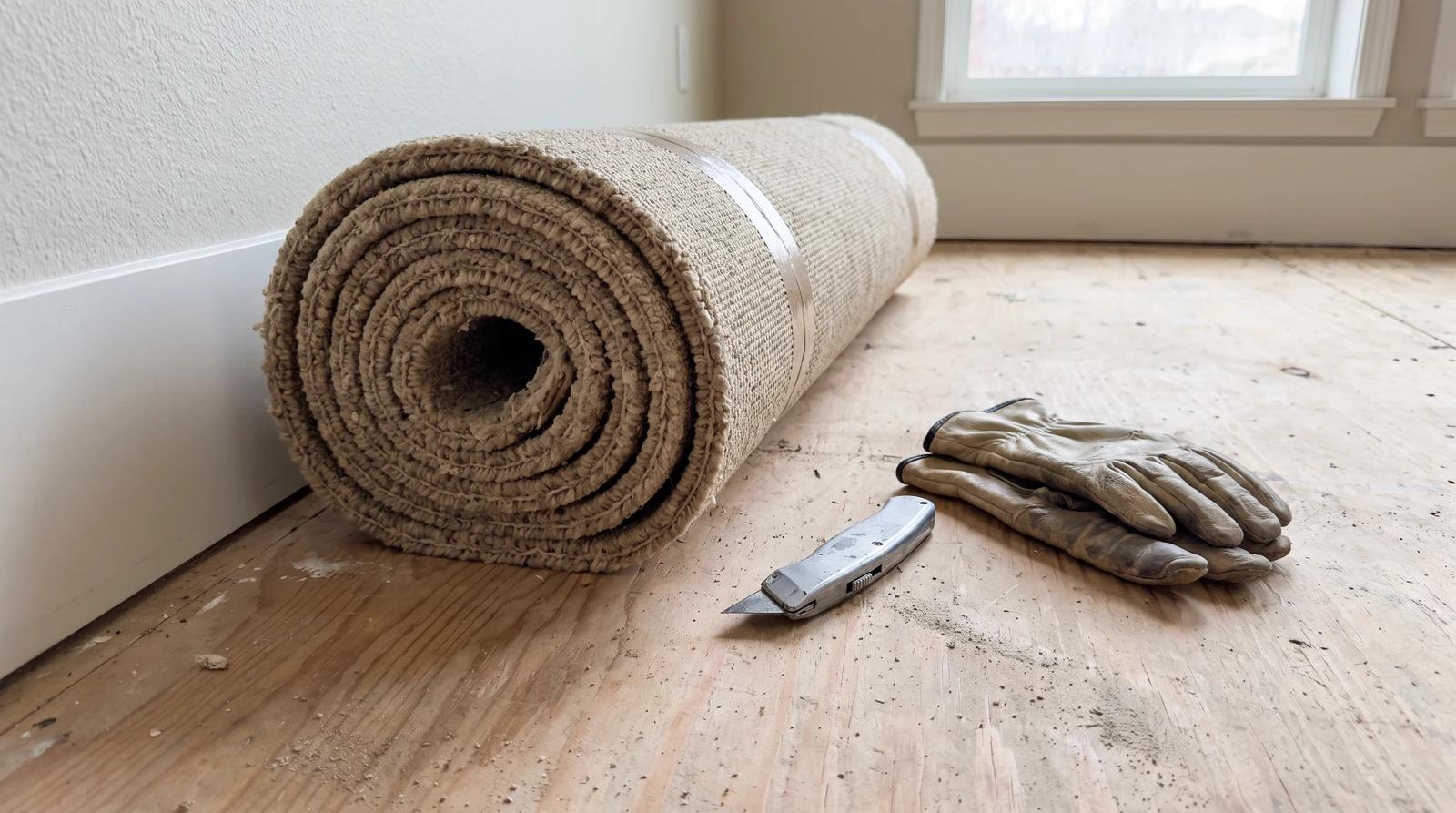
Fold a section back and cut through the backing from the underside. The best way to move it is in narrow strips, rolled tight and taped, since they move much faster than one huge piece dragged through the house.
Keep the blade moving parallel to the wall and angled down. A slip toward the baseboard leaves a gouge, and painted MDF trim, common in newer builds, chips easily.
Pull the pad and staples without prying against the trim
Pad is usually stapled to a wood subfloor, often heavily near the walls. Old pad and staples come up in that order: tear the pad out in sections, then go after what's left. A flat shovel is great for scraping pad and stuck foam in the open, but it's too wide to steer near the baseboard. Switch to pliers or a hand scraper there so nothing drives into the trim.
Lever the strips up and away from the baseboard
This is the step most likely to dent trim. Slip a flat bar under the strip at a nail and lever so the heel of the bar rests on the floor and the strip lifts up and away from the wall. Don't rest the bar against the baseboard.
If the strip sits tight to the trim, put a stiff putty knife or a thin scrap of wood between the bar and the baseboard first. Then go nail by nail. Yanking a long piece toward you drags the pins across the paint line, and going slow is much faster than patching a dented baseboard.
Quick tip: If you're replacing like for like, the better way is often to leave solid strips where they are. The new roll can usually go right onto them, which means no prying near the trim at all.
How to pull up carpet trim at doorways
At doorways, the edge usually ends under a metal or wood transition strip, so start there. Take out the screws or gently lift the strip's lip with a flat bar, then slide the edge out.
Metal grippers with teeth are nailed down and bend easily, so pry slowly, keep the bar off the door jamb and push away from the wall, the same rule we used along the baseboards. Where the pile meets a tiled bathroom or entry, the edge is often tucked under a reducer. You don't need to lift tile base trim or the reducer to free it. Slice along it with the same knife we used on the strips rather than yanking, so you don't chip the hard edge.
How can I pull up my carpet without damaging it?
The trick is to slow down at the edges and decide first what you're protecting: the trim, the wood underneath or the pile itself.
Protecting the baseboards and paint line
Put painter's tape along the bottom of the baseboards in each room before you start. It won't stop a bar, but it takes the scuffs from gloves, knees and rough backing.
Protecting the wood underneath
A lot of older homes in the North End and on the Bench have wood boards hiding underneath. A flat shovel is fine for clearing the middle, but take out leftover fasteners instead of scraping over them, and pry the strips up over a scrap of wood so the bar doesn't dent the boards. The nail holes along the edges are normal and get filled during sanding. A belt sander can work the open boards. Near the baseboard, though, a belt sander can catch the trim, so that's edger work for a refinishing pro. If the boards come back nicely, some people skip replacing them and add area rugs.
Newer homes around Meridian's Ten Mile corridor and Harris Ranch tend to have plywood or OSB under the pad. On that kind of base, clear every bit of old pad and staples, then leave a flat, clean surface for whatever design goes down next.
When you plan to put it back
If you only need to temporarily pull it back, say to run cables, fix a squeak or check a water spot, don't slice it. Release it along one or two walls, fold it back and leave the pad in place so it goes back down in good shape. Getting it tight again afterward is a restretch job, and a restretch job isn't something a knee kicker does well on its own. Hand that part to an installer.
Frequently asked questions
Can you replace carpet without removing baseboards?
Yes. The new roll hooks onto the existing strips and tucks into the same gap under the trim, and a restretch job isn't a reason to take trim off either. Swapping a damaged strip is the only part that brings tools close to the wall.
Do baseboards have to come off for hardwood or vinyl plank?
Not always. Floating vinyl plank usually works with the baseboards on and shoe molding covering the gap, while some hardwood installers prefer the trim off. It comes down to how tall the new layer sits and the look you want.
Should I take my baseboards off before a removal crew shows up?
No, unless your flooring contractors asked for them off. Taking trim off is its own chance to crack it, and a careful crew works around it. There's no reason to lift tile base trim at a bathroom doorway either.
What do I do with old carpet once it's up?
Rolled and taped strips load easily. Haul them to the Ada County Landfill or Canyon County's landfill, and check their current rules and fees before you load up.
Keeping the trim looking good
Free the edge, slice strips, pry away from the wall and let whatever goes down next decide whether the baseboards stay. That order is most of what keeps a DIY tear-out from turning into a paint job.
If you'd rather hand it off, we do Residential Carpet Removal across the Treasure Valley, from Eagle and Star to Kuna, Nampa and Caldwell. At the free on-site estimate, we look over the edges first: pinched trim, shoe molding, transitions and what's underneath. Then you get a firm price based on the space and the work, with no hidden fees, before anything is touched. Much of what we haul is donated or recycled.
Related reading: Is It Cheaper to Remove Carpet Yourself? What the DIY Bill Includes and Labor Cost to Remove Carpet: The Work Behind It and How to Trim It.
Related reading: Is It Cheaper to Remove Carpet Yourself? What the DIY Bill Includes and Labor Cost to Remove Carpet: The Work Behind It and How to Trim It.
Want us to take a look? Give us a call at (208) 314-4315.
Want us to handle it?
(208) 314-4315More From Our Blog
How to Remove Carpet Gripper From Wood or Concrete Without Gouging It
How to remove carpet gripper from a wood subfloor or concrete slab: where to pry, what to do with leftover nails, and how to bundle old strips safely.
How to Get Rid of Old Carpet: Trash, Recycling or a Removal Crew
How to get rid of old carpet: when your trash bin works, when your installer should haul it, and what a removal crew pulls, hauls, donates or recycles.
How to Remove Glued Carpet and Where All of It Goes Afterward
How to remove glued carpet with the end in mind: cut it, pull it, scrape the glue, then sort what can be donated, recycled or hauled to the landfill.
