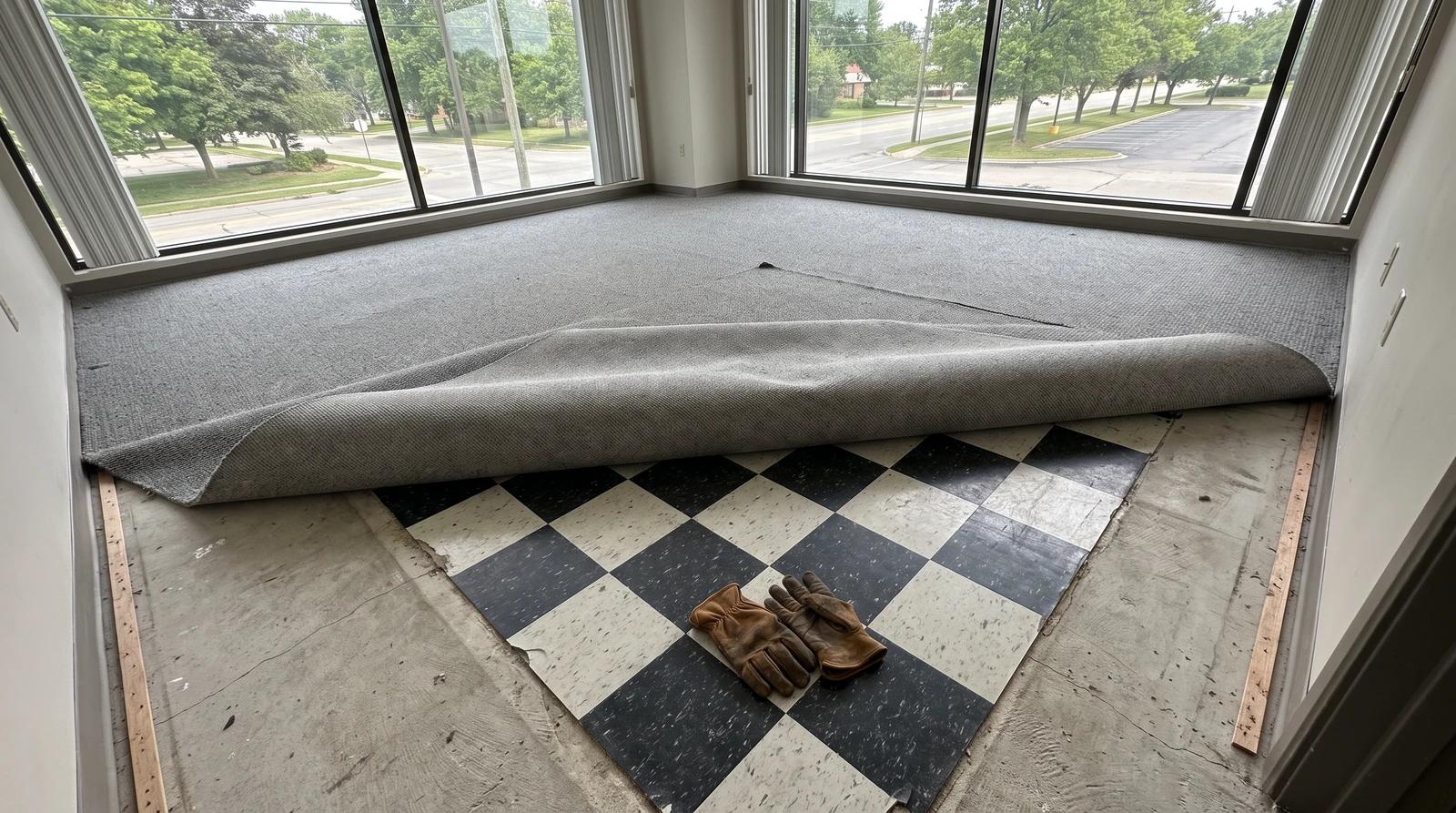
Commercial Carpet Removal in Boise: Old Tile and Black Mastic
Pull back a corner of carpet in an older office, church hall or strip-mall suite and you'll sometimes find a second floor under it. If you're planning commercial carpet removal in Boise, that layer of small square vinyl tile can matter more than the carpet does. It's sometimes stuck down with dark, tar-like glue.
Here's what that layer is, why it slows the tear out down, and how to handle it so a simple job doesn't get expensive.
Why older buildings hide a second floor
For a long time, commercial carpet went right over whatever floor was already there. That was faster and cheaper than pulling the old floor, so plenty of buildings ended up with two or three layers stacked up.
You'll find it all over the valley: older offices near downtown Boise, converted spaces on the Bench, church halls in Nampa and Caldwell, and small retail buildings on the older streets of Meridian and Emmett.
The carpet is usually the easy part. The floor under it is what needs some thought.
What old tile and black mastic can mean
Here's the honest part. Some older vinyl floor tile was made with asbestos, and so was some of the black adhesive used to glue it down. Not all of it, though. Plenty of old tile is harmless.
The catch is that you can't tell by looking. Color, size and pattern don't settle it, and the age of the building doesn't either. The only way to know is a lab test.
Intact tile sitting under carpet isn't much of a hazard. It becomes one when it's broken, sanded, scraped or ground. That's exactly what happens when someone gets rough pulling glued carpet off the tile, or when an installer comes in later to grind the floor flat.
So the real question isn't "is there asbestos in my building?" It's "is anyone about to disturb something nobody's tested?"
Heads up: Commercial buildings fall under federal asbestos rules that call for an inspection before renovation work disturbs suspect materials. If your space is older and you don't know what's under the carpet, have an accredited inspector take a sample before anyone schedules the tear out. Idaho DEQ is a good first stop if you have questions about what applies to your building.
Carpet removal before new flooring goes in
If the test comes back clean, good. The carpet comes up, the pad and tack strip come out, and you decide whether the old tile stays as a base or gets pulled for the new floor.
If the test comes back positive, the plan changes. The carpet may still be able to come up, as long as it's pulled without breaking or scraping the tile underneath. Anything that disturbs the tile or the mastic is work for a licensed abatement contractor, not a carpet removal crew.
We don't haul asbestos or any other regulated material. If suspect tile turns up under carpet and nobody's tested it, the right move is to stop and talk it through before going further. Yes, that can push your schedule back. That still beats finding out after the floor's been ground up and the dust has gone through the HVAC.
Bring your flooring installer in early, too. Many new floors, luxury vinyl plank and carpet tile especially, need a flat, clean surface. Sometimes that means the old tile has to go, which puts you right back at testing.
What moves the cost of carpet removal in Boise
We price commercial jobs by the space and the work involved. You get a free on-site estimate with a firm price before anything gets touched. In older buildings, a few things move that price and the schedule.
How the carpet is attached. Stretched carpet over pad comes up pretty quickly. Carpet glued straight to old tile takes more care, especially if the tile has to stay in one piece.
Whether testing is done. If you have results in hand when we walk the space, there's nothing to wait on. If you don't, testing comes first and the tear out gets scheduled after.
Access. A second-floor suite with one narrow stairwell is a different job from a ground-floor space with a back door you can prop open. If the business has to stay open while the work happens, that affects the schedule as well.
Volume and disposal. More square footage means more carpet and pad to haul. A good share of what we haul gets donated or recycled when it's in decent shape. What can't be reused goes to the landfill, which for most Boise and Meridian loads means Ada County's. Canyon County runs its own, so carpet from Nampa, Caldwell or Middleton may go there instead.
The season matters too. Summer gets busy for commercial flooring because schools, churches and offices tend to plan their updates for then. If you're looking at a summer project, line up testing and estimates in spring.
A few mistakes worth skipping
Don't let a well-meaning employee or volunteer start ripping out carpet on a Saturday to save money. Tearing glued carpet off untested tile is exactly what those rules are meant to prevent.
Don't assume a newer-looking building is fine, either. Remodels can hide much older floors under fresh finishes.
And don't leave your flooring installer out of the planning. If they need a bare slab, you want to know that before the carpet comes up, not after.
Before you book the tear out
If your building has some years on it, look under a corner of carpet before you start collecting estimates. Old tile or black glue doesn't mean you're stuck. It just means the test comes first and the carpet comes second.
Yes, we'd like the job. But honestly, getting that test done matters more than who pulls the carpet. When you're ready for the carpet and pad to come out, whether you're in Boise, Kuna, Eagle or anywhere else in the Treasure Valley, give us a call at (208) 314-4315. We'll come take a look with you and give you a firm price. No pressure either way.
Want us to handle it?
(208) 314-4315More From Our Blog
Carpet Removal Between Tenants in Boise: A Landlord's Prep Guide
Pulling carpet between tenants in Boise? How to time the tear-out with your turnover, document damage for the deposit and get the floor ready for new renters.
Commercial Carpet Tile Removal in Boise Before New Flooring
Carpet tiles come up differently than broadloom. Here's what commercial carpet tile removal in Boise really involves, from adhesive to stacking and disposal.
Mobile Home Carpet Removal in Boise Before New Flooring
Mobile home carpet removal in Boise takes a lighter hand. Here's what's under the carpet, where soft spots hide, and how to prep the floor for new flooring.
