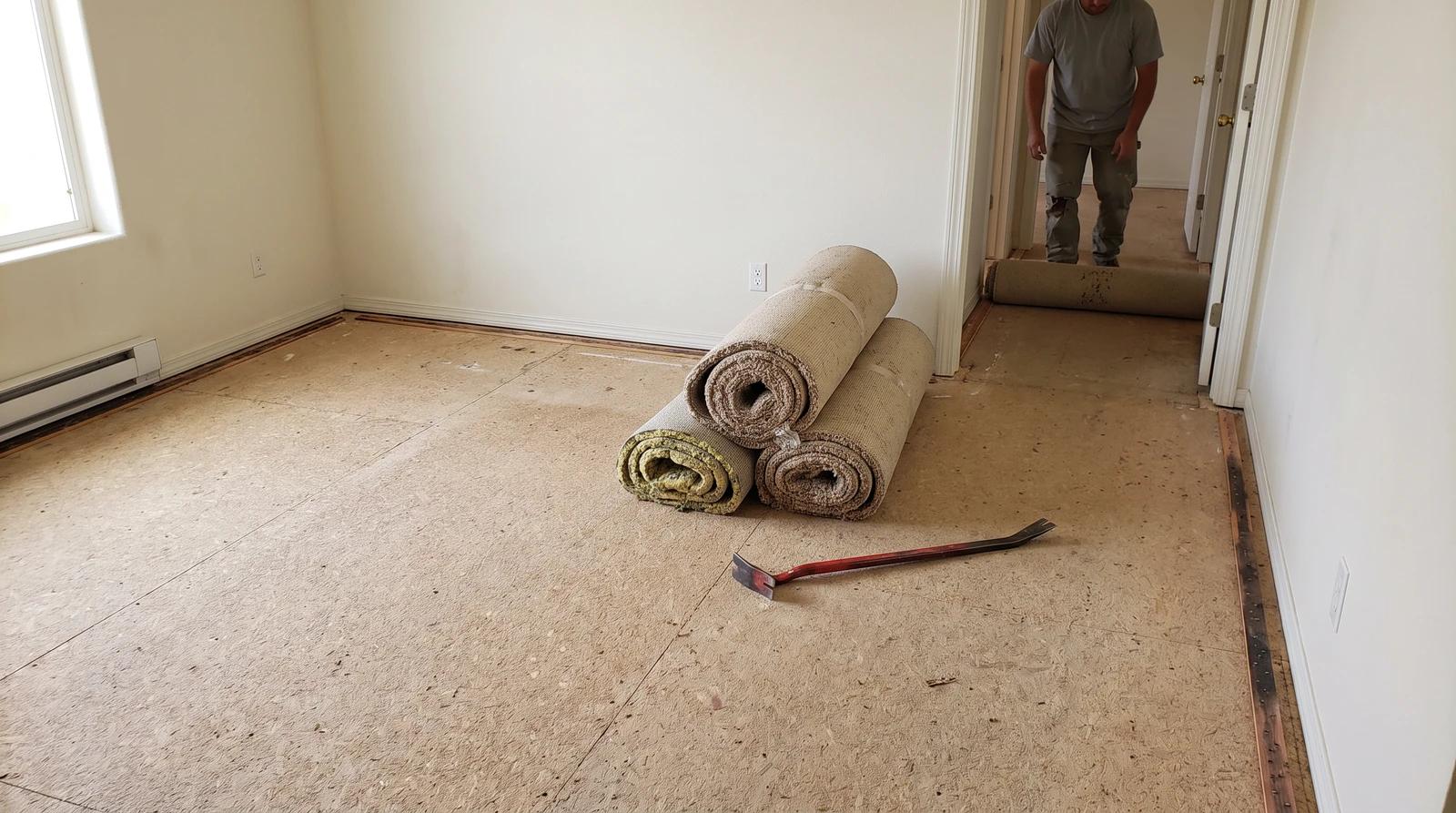
Mobile Home Carpet Removal in Boise Before New Flooring
You've finally decided the carpet in your manufactured home has to go. Maybe it's the original stuff, worn flat into paths between the couch and the kitchen. Before you grab a utility knife, know that carpet removal in Boise works a little differently when the home came off a factory line.
Tearing it out isn't harder. What's underneath is different, and that changes how careful you need to be.
What's under the carpet in a manufactured home
Pull carpet in a site-built house in the North End or on the Bench and you'll usually find plywood, OSB or sometimes old hardwood. Manufactured homes, especially older ones, often have particleboard or a similar pressed-wood subfloor instead.
Why does that matter? Particleboard handles foot traffic just fine. It doesn't handle water, and it doesn't like being pried at.
If it's ever gotten wet from a leaky water heater, a dishwasher line or a bathroom with years of splashing behind it, it can swell, go soft and crumble at the edges. You often can't tell until the carpet and pad are off.
The other surprise is how the carpet went in. In a lot of manufactured homes, the flooring was laid at the factory before some interior walls were set. So the carpet can run under the walls instead of stopping at a tack strip along the baseboard.
You can't just roll that up. It gets cut cleanly along the wall line, and the piece trapped underneath stays where it is.
Carpet and pad removal without wrecking the subfloor
The goal is simple. Get everything off and leave a floor that's ready for whatever goes down next. In a manufactured home, that just takes a lighter hand.
Cut the carpet into strips you can actually carry. Narrow rolls are a lot easier to get through the tight hallways and doors these homes tend to have.
The pad is usually stapled, sometimes glued in spots. Pulling it up goes quick. The staples left behind are the slow part, and every one needs to come out or get driven flush before new flooring goes in.
Tack strip, where there is any, is nailed into that same subfloor. Pry it too hard and a chunk of particleboard comes up with it. Work it loose a few inches at a time and you'll save yourself a patch job later.
Heads up: If you find sheet vinyl or old tile under the carpet in an older home, don't scrape or sand it until it's been tested. Some older flooring and adhesives contain asbestos, and it's disturbing them that causes the problem. Sending a sample to a lab is a small step worth taking before anyone starts scraping.
Find the soft spots before your new floor does
Once the floor is bare, walk it. Slowly. Pay extra attention near the bathroom, the kitchen sink, the water heater closet and any exterior door.
A spongy feel, a raised edge or a dark stain usually means water got in at some point. That section needs to be cut out and replaced before anything goes over it.
This is where it helps to know what's going down next. Luxury vinyl plank, laminate and tile all want a flat, solid surface. Some are more forgiving than others, but none of them will hide a soft subfloor for long.
We're a removal crew, so we'll tell you straight what we see once the carpet's up. Subfloor repair is its own job, though, and you'll want it lined up before your flooring installer shows up.
Carpet removal in Boise-area parks: rules, access and the dump run
If your home sits in a park, whether that's in Garden City, Nampa, Caldwell or out toward Kuna and Star, read the community rules before you schedule anything. Some parks limit work hours, where a trailer or dumpster can sit and how long debris can stay outside.
Access matters more than people expect, too. Steps up to the door, narrow entries and tight turns all change how the work goes and how long it takes.
And carpet adds up fast. Once you count every room plus the pad, a modest single-wide makes a bigger pile than most people picture.
You can haul it yourself to the Ada County landfill or a Canyon County transfer site. Check current hours and fees first. Wet carpet is a lot heavier than dry, which is good to know before you try to lift a roll of it.
When we haul it, we look for anything that can be recycled or donated before the rest goes to the landfill. Clean, newer pad and remnants sometimes get a second life. Old, stained carpet usually doesn't.
Doing your own carpet removal in Boise, or handing it off
Honestly, plenty of people can do this themselves. A free weekend, good gloves, a sharp knife and a plan for disposal will get you most of the way.
Where it gets tricky is the subfloor. Rushing the tack strip, gouging particleboard or missing a soft spot can turn a simple flooring project into a bigger one. Yes, we'd love the work, but the most useful advice we can give is free: go slow around the edges, test anything old before you scrape it, and walk the bare floor before new flooring goes in.
If you'd rather not spend your weekend on your knees pulling staples, Boise Carpet Removal works across Boise, Meridian, Nampa and the rest of the Treasure Valley. We'll come out, look at the space and give you a firm price before anything's touched. Give us a call at (208) 314-4315 whenever you're ready.
Want us to handle it?
(208) 314-4315More From Our Blog
Carpet and Pad Removal in Boise When There's Hardwood Underneath
Think there's hardwood under your old carpet? Here's how to check, what carpet and pad removal leaves behind, and how to save the wood in Boise homes.
Carpet and Pad Removal in Boise for Pet Odor That Won't Quit
Pet odor that comes back after shampooing usually lives in the pad and subfloor. Here's what carpet and pad removal in Boise involves and what comes next.
Old Carpet Removal and Disposal in Boise: Where It All Goes
Pulling up old carpet is the easy part. Getting rid of it is harder. Here's how carpet removal and disposal works in Boise and where the old stuff ends up.
