Carpet Removal Before New Flooring: Timing Boise Installs Right
With carpet removal before new flooring, timing Boise installs right comes down to one rule: get the old carpet out early enough to fix what's under it, but not so early you're stuck on bare plywood. Ask your installer who handles tear-out and how they want things left, then book removal around their date.
Whether it's vinyl plank in a Nampa kitchen or hardwood in a Boise bedroom, the order of tear-out is the same, and it isn't complicated.
Is it hard to remove carpet yourself, or will your installer do it?
Not really, it's mostly slow work. First, though, find out whose job it is. Some Boise installers build tear-out into their price, some list it as a separate charge, and plenty of others expect a bare floor when they walk in the door.
Ask before you assume. A lot of flooring projects stall because the homeowner thinks the installer's handling it, and the installer thinks the homeowner is.
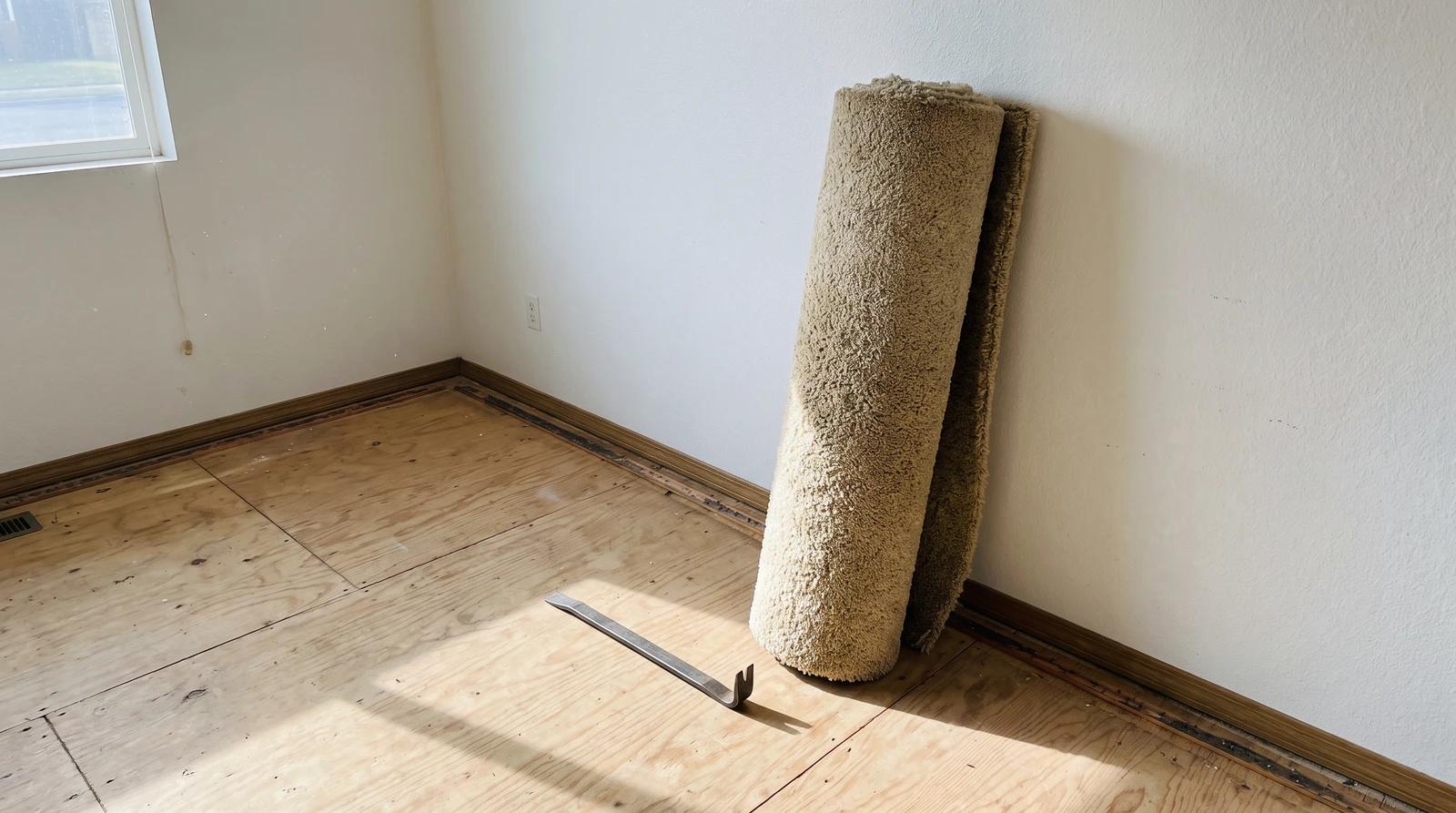
If tear-out isn't on their list, do it yourself with a utility knife, pliers and a pry bar, or have a professional carpet crew remove it all and haul it away. Either way, most installers want the same thing: carpet, pad, tack strip and staples gone, and the subfloor swept clean.
Pad staples left in the subfloor can keep a floating floor from sitting flat, and under thinner products they can show through over time. Chunks of old pad stuck to a concrete slab cause the same kind of trouble.
The type of flooring going down changes the prep. Tile needs a flat, solid base or it can crack, thin vinyl shows small bumps, and nail-down hardwood can't go straight onto a concrete slab like tile or vinyl can.
Carpet removal before new flooring: timing Boise install day
Time tear-out close to install day, but not too close.
Pull it too early and you're living on bare plywood or concrete longer than you'd like. It's rough on socks, kids and pets, and in a Boise or Nampa winter a bare slab gets cold fast.
Pull it up the same morning the installers show up, though, and you lose your chance to catch problems. That's the bigger risk.
Once the carpet and pad come up, you finally see what's been hiding under there. Maybe it's a soft spot from an old leak, pet stains that soaked into the wood, a squeaky seam or a crack in the slab. All of that needs fixing before the new floor goes down, and your installer may not have time set aside for repairs.
So leave enough room between tear-out and install for a professional to look at the bare floor and fix what turns up. How much room depends on your installer's schedule and how much repair the subfloor needs. Stairs, a soft or stained area, and furniture and area rugs that have to move can all stretch that gap.
Quick tip: Before tear-out day, ask your installer exactly how they want the subfloor left. Strips pulled, or left along the walls? Staples pulled, or just flush? Scraped, or only swept? Different products need different prep, and knowing ahead means the room is ready for install instead of almost ready.
Pick the new floor before you book tear-out
Many showrooms around Boise and Nampa have an inspiration gallery, in the store or online, that shows tile, vinyl and hardwood in real rooms instead of on a small sample. Look for rooms like yours, say a bedroom with area rugs, and save a few photos for your installer.
A photo won't show how a floor holds up, so ask:
- What regular care and cleaning does it need?
- What care keeps pet scratches down?
- Is that vinyl or tile a good fit for wet areas?
- What rug pad is safe under area rugs on it?
The dry Treasure Valley air and acclimation
A lot of flooring, especially solid hardwood and some engineered products, has to sit inside your house before it's installed so it can adjust to your home's temperature and humidity. The manufacturer's instructions say how long and under what conditions, and they really do vary from product to product.
The Treasure Valley is dry, and indoor humidity swings with the seasons. A house running the AC through a Boise, Meridian or Nampa summer is a pretty different place from the same house with the furnace going all January. Keep your heating or cooling running the way it normally does while the flooring settles in.
Why does that matter for tear-out? Those boxes usually need to sit in or near the rooms where they'll go. Figure out where they'll be stacked, and whether the carpet has to be out before they arrive.
Getting your Boise home ready for the removal process
Start with furniture. Decide who's moving it and where it's going. A garage or a room nobody's touching works fine for it and any area rugs. Don't forget the closets, which tend to collect shoes, boxes and things nobody's looked at in years.
Then think about the path out. Rolled carpet and bagged pad are bulkier and heavier than they look, so a clear route from each room to the front door or garage speeds things up. Take care of anything fragile near doorways, since long rolls swing wide.
Older homes in Boise's North End or up on the Bench often have tighter stairs and hallways than newer builds out in Kuna, Star, Nampa or along the Ten Mile corridor. That just means more maneuvering and extra care on the stairs.
Plan on some dust, too. Old carpet pad crumbles. Keep pets and kids out of the work area, shut the doors to rooms that aren't involved, and swap your furnace filter once it's all done. In winter, turning the thermostat down while the door's propped open for the rolls is worth it.
As for what comes out, carpet in decent shape can often be donated or recycled, and we try to send as much as we can that way. Whatever can't be reused goes to the landfill. A professional carpet crew can remove carpet, padding, strips and staples and haul it all away, leaving the room ready for the next step.
Heads up: Pulling carpet yourself? Take care with the strips, since the nails point up, and use a flat pry bar to pull them. Ada and Canyon counties each run a landfill, so check the current rules for carpet at the one nearest your Boise or Nampa home.
A quick word on permits. Pulling up carpet usually doesn't need one. If your project grows into taking out walls or other demolition, that's a different story, so check with your city. We can handle the permit application for that kind of work.
How long does a carpet install take?
It depends on the rooms, stairs, furniture and repairs involved. A professional installer can give you a time after measuring your home, and having the old carpet out first keeps that day on track.
Here's the short version of the replacement process:
- Pick your tile, vinyl or hardwood with care, using an inspiration gallery or samples.
- Find out whether your installer handles carpet tear-out.
- Get their subfloor requirements.
- Book removal early enough for repairs, but not so early you're living on plywood for weeks.
- Let the new flooring acclimate if the box calls for it.
Replacing floors in a Boise or Nampa home goes easier when each step has a date.
We'd be glad to take that part off your plate. We do free on-site estimates anywhere in the Treasure Valley, from Boise to Nampa, with a firm price before anything gets touched and same-day service when the schedule allows. Call Boise Carpet Removal at (208) 314-4315 and we'll work around your install date.
Frequently asked questions
Is it hard to pull up carpet padding yourself?
Not hard, just slow and dusty. Stuck pad and staples take the most time, so keep pliers and a scraper handy, or have a crew do it for you.
Does trim get installed before carpet?
Usually, yes. Baseboards go on first and the carpet tucks against them. With tile and hardwood it often goes the other way, so ask whether your installer will remove the baseboards.
Is it worth replacing carpet with laminate?
The Residential Carpet Removal page covers what the service includes and how the estimate works.
Related reading: How to Remove Carpet Without Cutting It and Keep It in One Piece and How to Remove Carpet Without Removing Baseboards (and Keep Them Clean).
It can make sense in rooms with pets, spills or heavy foot traffic, since laminate, vinyl and tile clean up easily. Carpet feels warmer than hardwood or laminate, though area rugs help. Weigh how each room gets used and how much care you want to give.
Want us to handle it?
(208) 314-4315More From Our Blog
How to Remove Carpet Gripper From Wood or Concrete Without Gouging It
How to remove carpet gripper from a wood subfloor or concrete slab: where to pry, what to do with leftover nails, and how to bundle old strips safely.
How to Get Rid of Old Carpet: Trash, Recycling or a Removal Crew
How to get rid of old carpet: when your trash bin works, when your installer should haul it, and what a removal crew pulls, hauls, donates or recycles.
How to Remove Glued Carpet and Where All of It Goes Afterward
How to remove glued carpet with the end in mind: cut it, pull it, scrape the glue, then sort what can be donated, recycled or hauled to the landfill.
