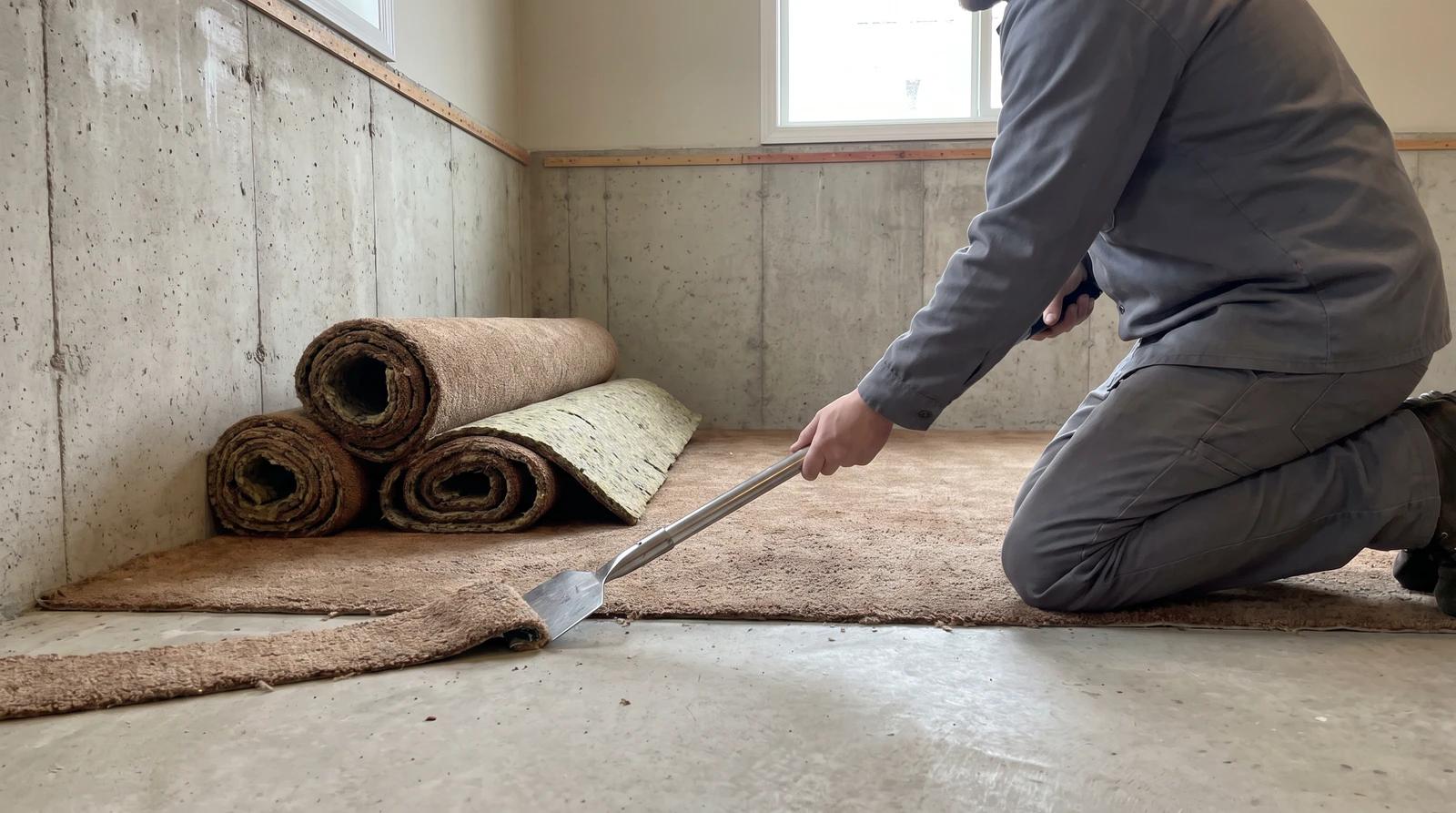
Glued-Down Carpet Removal in Boise Before New Flooring
Most carpet removal in Boise goes about how you'd expect. You peel back a corner and find pad, tack strip and a subfloor that's been sitting under there for years.
Every so often, though, you peel back a corner and there's no pad. No tack strip either. Just a layer of tan glue holding the carpet flat to the concrete.
It's a common surprise in basement rec rooms. A homeowner pulls up a corner, looks at the mess and stops. Honestly, good call.
If you're planning carpet removal before new flooring and the old stuff turns out to be glued down, it's worth knowing what you're in for before you book the installer.
Where glued-down carpet shows up around the Treasure Valley
Most carpet in homes is stretched over a pad and hooked onto tack strip around the edges. Glue-down is the other kind. It's stuck straight to the subfloor, usually concrete, with nothing in between.
We see it most in finished basements, older offices and church fellowship halls. Plenty of 70s and 80s houses on the Bench have it downstairs. Garden City has a lot of older commercial spaces with it, and so do ground-floor condos built on a slab.
So how do you tell which one you've got? Pull back a corner inside a closet or at a doorway.
Foam pad underneath means it's stretched. If the back of the carpet is stuck to the floor and comes up with chunks of gray or tan residue, it's glued.
Why glue-down carpet removal in Boise takes longer
Stretched carpet comes up fast. You cut it into strips, roll it, pull the pad, and you're mostly onto the tack strip.
Glued carpet fights you the whole way.
It tears instead of peeling, especially once the adhesive has had decades to cure. You end up cutting narrow strips and working each one loose with a floor scraper. Some sections let go without much trouble. Others act like they were poured in place.
And getting the carpet up is maybe half the job. The other half is the glue left behind, because the floor has to end up flat and clean enough for whatever's going down next.
That's why we price by the space and the work involved, and why we look at it in person first. Two rooms the same size can be very different jobs depending on how much adhesive went down and how well it's held. You get a firm price at the estimate, before anything is touched, and it doesn't change when we hit a stubborn patch.
What your new floor needs from the slab
People tend to skip this part. It's usually the part that bites them later.
Luxury vinyl plank and other floating floors want a flat surface. Ridges of old glue can telegraph through thin vinyl or leave planks sitting a little uneven.
Tile is fussy in a different way. The thinset needs something clean and solid to grab onto, not a skin of old adhesive.
Going back down with new glue-down carpet or sheet vinyl? Then the old adhesive needs to be scraped smooth so the new glue isn't sitting on a weak layer.
Your installer will have their own standard, so ask them before demo day what condition they want the slab in. Then tell us. We'd much rather scrape to their spec once than have them show up, look at the floor and reschedule.
Heads up: If your home was built before the 1980s, black "cutback" adhesive under old carpet or tile can contain asbestos. Have a sample tested before anyone sands, grinds or scrapes it. It's a short delay, and the result tells you how that floor needs to be handled.
Can you pull glued carpet yourself?
Sometimes, yes. We'd love the work, but a small basement office is doable with a sharp utility knife, a long-handled floor scraper, good knee pads and a free weekend.
Where it goes sideways is size. A whole basement in Kuna or a ground-floor office in Nampa turns into days on your knees.
Then there's the pile. Torn, glue-backed strips don't roll up neatly and won't fit in your trash cart, so you're looking at a trip out to the Ada County landfill or a Canyon County transfer station.
One more honest note. Clean stretched carpet can sometimes get a second life, but glued carpet almost never comes up in reusable shape. We still sort every load and recycle or donate whatever we can. Less of it qualifies, that's all.
Carpet removal before new flooring: get the order right
Here's one we see in Eagle and Meridian remodels all the time. The flooring's ordered, the installer's booked, and nobody has figured out who's taking the old carpet out.
Schedule the removal first, ideally with a little cushion before the install. That leaves you some room if the slab needs extra scraping.
It also gives your installer a chance to check the concrete for moisture. Treasure Valley basements can hang onto it after a wet spring or a big snowmelt, and a lot of installers want to test before they lay anything.
We can sometimes do same-day service. With glue-down jobs, though, we'd rather give you a realistic day than squeeze you in and rush the scraping.
The bottom line
Glued-down carpet is a slower, messier pull than stretched carpet, and what's left on the slab matters as much as what comes up. Find out what your installer needs, check for old black adhesive, and book the removal before the install date.
If you want a firm price on carpet removal in Boise or anywhere else in the Treasure Valley, give us a call at (208) 314-4315. We'll come take a look at the floor, tell you what we see, and you can decide from there. Cash, card and Venmo all work.
Want us to handle it?
(208) 314-4315More From Our Blog
Mobile Home Carpet Removal in Boise Before New Flooring
Mobile home carpet removal in Boise takes a lighter hand. Here's what's under the carpet, where soft spots hide, and how to prep the floor for new flooring.
Carpet and Pad Removal in Boise When There's Hardwood Underneath
Think there's hardwood under your old carpet? Here's how to check, what carpet and pad removal leaves behind, and how to save the wood in Boise homes.
Carpet and Pad Removal in Boise for Pet Odor That Won't Quit
Pet odor that comes back after shampooing usually lives in the pad and subfloor. Here's what carpet and pad removal in Boise involves and what comes next.
