Carpet and Pad Removal in Boise When There's Hardwood Underneath
You've probably done it already. You pulled up a corner of carpet in the closet, saw a strip of honey-colored wood, and started wondering what the rest of the house looks like underneath.
If that's got you thinking about carpet removal in Boise, it's a good instinct. It's also worth doing carefully.
A lot of older homes around the Treasure Valley were built with wood floors that got covered up later. Carpet was the popular upgrade for a long time. So plenty of houses in Boise's North End, on the Bench, and in the older parts of Nampa and Caldwell have oak or fir hiding under a layer of pad and tack strip.
Sometimes it's in great shape. Sometimes it isn't. Here's how to find out before you commit, and what carpet and pad removal actually involves when you want to keep the floor underneath.
How to check for hardwood before carpet removal in Boise
You don't have to tear up a whole room to get a good look. Start where nobody will notice.
Closets are the easiest. Grab the carpet at a corner with pliers, fold it back, and look at what's under the pad.
Heat registers give you another quick peek. Lift the vent cover and you can often see the edge of the flooring right there in the cutout.
Check doorway transitions too. Where carpet meets a bathroom or kitchen, the edge sometimes shows what's under it.
One spot doesn't tell you about the whole house, though. It's common to find hardwood in the original rooms and plywood or particleboard everywhere else. A bedroom added on later, a converted garage, or a finished basement in a Meridian or Kuna home is often a different story.
What carpet and pad removal leaves behind on wood
This is the part people don't expect. Pulling the carpet goes fast. Dealing with what's under it is the slow part.
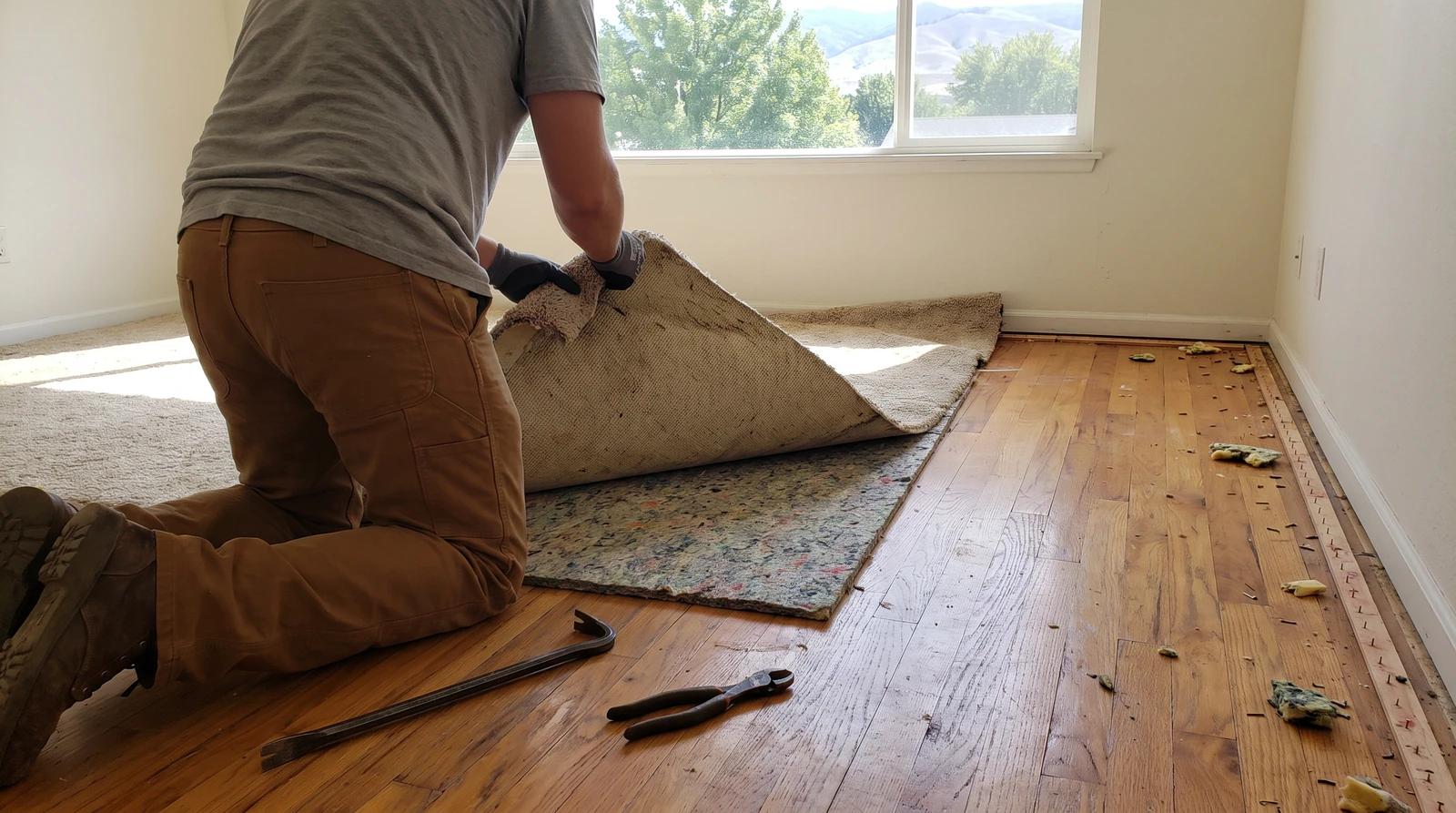
Pad staples are the big one. Older pad was often stapled straight into the wood, and there can be a lot of them. Every one has to come out, or it'll catch a sander and scar the floor.
Tack strip runs along every wall. It's nailed down, and if you pry it up carelessly you'll gouge or splinter the edge of the boards.
Then there's the stuff you can't control. Old pet accidents soak through the pad and leave dark stains in the wood, and a leaky window can leave the same kind of mark.
You might also find paint overspray where someone rushed the baseboards. Or a patched section where a wall used to be.
None of that means the floor is a lost cause. It just means you won't know its real condition until everything's up.
Heads up: If you find old tile or black adhesive under the carpet instead of wood, especially in a house built before the 1980s, don't scrape or sand it. Some older floor tile and mastic contained asbestos. Get it tested before anyone disturbs it.
Taking it up without wrecking the wood
If you want to save the hardwood, the removal has to be slower and more careful than a straight tear-out before new flooring goes in.
The carpet gets cut into strips, rolled and carried out instead of dragged across the floor. The pad comes up next, then the staples get pulled one at a time. Tack strip comes up with a flat bar, with a scrap of wood under the bar to spread the pressure so the boards don't crack.
Can you do it yourself? Sure. Honestly, it isn't complicated.
It's just tedious and hard on your knees. And it's easy to rush near the end when you're sick of it, which is exactly when a board you were trying to save gets gouged.
Summer makes it harder. Old carpet and pad hold a lot of dust, and a closed-up house in a Boise July gets stuffy fast. If you're tackling it yourself, mornings are a lot more pleasant.
Where the old carpet goes
Once it's up, you've got a pile of rolled carpet, pad and broken tack strip with nails sticking out of it. It's bulky, and it won't fit in your trash can.
You can haul it to the Ada County landfill yourself if you live in Boise, Meridian, Eagle or Garden City, or to the Canyon County landfill if you're out in Nampa, Caldwell or Middleton. Check their current hours and fees before you load up, and wrap the tack strip so nobody gets poked.
What about permits? Pulling carpet usually isn't the kind of work that needs one. If you're also cutting out subfloor, moving walls or doing anything structural, check with your city's building department first.
Before you call a refinisher
Once the floor is bare, sweep it, vacuum the seams, and walk it in good light. Look for soft spots, deep stains, and boards that move when you step on them.
That's what a refinisher will want to know. It's also what decides whether you need a light sanding or real repair work.
Worth a look either way
Finding hardwood under old carpet can be a really nice surprise. Just keep your expectations realistic: peek first, pull it up carefully, and don't judge the floor until the staples and tack strip are gone.
If you'd rather hand off the carpet and pad removal and the haul-away, give us a call at (208) 314-4315. We'll come out for a free look at the space and give you a firm price before we touch anything. No pressure either way.
Want us to handle it?
(208) 314-4315More From Our Blog
Mobile Home Carpet Removal in Boise Before New Flooring
Mobile home carpet removal in Boise takes a lighter hand. Here's what's under the carpet, where soft spots hide, and how to prep the floor for new flooring.
Carpet and Pad Removal in Boise for Pet Odor That Won't Quit
Pet odor that comes back after shampooing usually lives in the pad and subfloor. Here's what carpet and pad removal in Boise involves and what comes next.
Old Carpet Removal and Disposal in Boise: Where It All Goes
Pulling up old carpet is the easy part. Getting rid of it is harder. Here's how carpet removal and disposal works in Boise and where the old stuff ends up.
